
The compact Technology Educational Satellite, or TechEdSat-6, was recently launched to the International 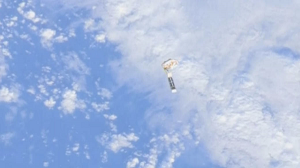 The TechEdSat-6 Exo-Brake deployment on November 20, 2017. Source: NASASpace Station on Orbital ATK’s Cygnus spacecraft from NASA’s Wallops Flight Facility. The satellite – about the size of a loaf of bread – is one element in a continuing program to demonstrate the "Exo-Brake" parachute device, advanced communications and wireless sensor networks.
Released into low-Earth orbit from the NanoRacks platform, TechEdSat-6 is conducting a series of wireless sensor experiments that will be the first self-powered tests, expanding the capabilities of sensor networks for future ascent or re-entry systems. It is also the fourth TechEdSat carrying an updated version of the Exo-Brake that will demonstrate guided controlled re-entry of small spacecraft to safely return science experiments from space.
“The Exo-Brake’s shape can be changed to vary the drag on the satellite. With the help of high-fidelity simulations, we will demonstrate a low-cost, propellant-less method of returning small payloads quickly, and to fairly precise locations, for retrieval,” said Michelle Munk, NASA’s System Capability Lead for Entry, Descent and Landing. “We are excited about tracking TechEdSat-6 as it re-enters the atmosphere.”
While the goal of returning samples from the space station and orbital platforms is integral to the project, NASA seeks to develop building blocks for larger-scale systems that might enable future small spacecraft missions to reach the surface of Mars and other places in the solar system.
