
Researchers from the Universities of Bristol and Bedfordshire, in collaboration with ABB, have designed and tested a series of plasmonic nanoantenna arrays that could lead to a new generation of ultrasensitive and low-cost fluorescence sensors to monitor water quality.
The arrays were conceived by Dr. Neciah Dorh during his Ph.D. at the University of Bristol. They are made from aluminum nanorods fabricated using electron beam lithography by commercial partner Kelvin Nanotechnologies. The nanorods, 50 nm wide and 158 nm long are designed to resonantly enhance fluorescence emission from a range of contaminants in the water like diesel or tryptophan.
The work shows a six-fold increase in measured fluorescence emission from a dye. The research shows that by correctly designing the array element spacing, strongly directional fluorescent emission can be obtained that would allow for highly integrated multi-wavelength sensors to be designed.
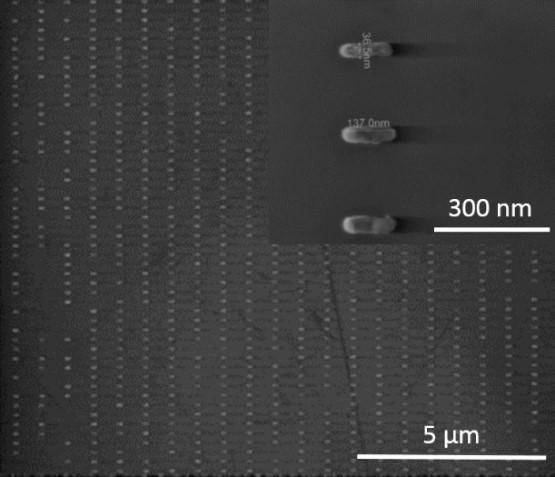 SEM images of nanoantenna array and in the inset a magnified view of the array elements. (University of Bristol)
The work was carried out by Professor Martin Cryan’s research group, which was part of the photonics research group in the department of electrical and electronic engineering.
The project was a collaboration between Dr. Andrei Sarua from the School of Physics at Bristol and Dr. Tahmina Ajmal from the University of Bedfordshire, who had previously worked on the Aquatest project at Bristol.
The team developed a prototype low-cost, LED-based sensor system that they plan to further develop into a hand-help deployable system for performing water quality monitoring.
Martin Cryan, professor of applied electromagnetics and photonics in the department of electrical and electronics engineering at the University of Bristol and co-author on the paper, said, “The nanoantenna arrays, which can be fabricated by lower cost production techniques such as nanoimprint lithography, can bring significant sensitivity enhancement so that laboratory quality measurements could be carried out in the field. This would allow for deployment of remote wireless sensor networks for early warning of pollution or continuous monitoring of water quality in sensitive environments."
Dr. Dorh is developing quantum enhanced fluorescence sensors which will help identify bacteria within minutes rather than days.
The group is developing systems that could combine the power of nanoantennas with quantum enhanced sensors to produce yet further sensitivity enhancements.
A paper on this research was published in Applied Optics.
