
A shortage of sign language interpreters in Belgium prompted three masters students at the University of Antwerp to develop a 3D-printed robotic to perform this function.
Project Aslan (Antwerp’s sign language actuating node) is not intended to replace human sign language translators but rather to provide support when they are not available. The Aslan robot might also be used to help teach sign language with a human teacher so as to expand the capacity of such instruction.
The use of 3D printing combined with readily available components will make the robot affordable and easily manufactured. The project relies on 3D Hubs, a network of 3D printing services available globally on one online platform, which should allow production of Aslan in over 140 countries.
The first iteration is a 3D-printed robotic arm with the ability to convert text into sign language, including finger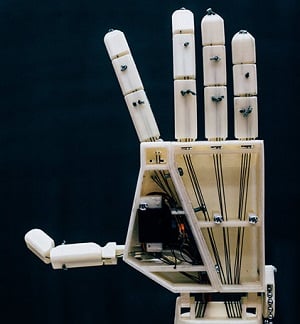 The 3D-printed Aslan robot. Source: University of Antwerp spelling and counting. The initial prototype was composed of 25 parts, which were 3D-printed over a 139-hour timeframe, along with 16 servo motors, 3 motor controllers, an Arduino Due and other components. The researchers printed the robotic system parts with Polylactic Acid (PLA)-filament on a desktop 3D printer
The Aslan robot, assembled in about 10 hours, receives information from a local network and checks for updated sign languages from all over the world. Users connected to the network can send messages, which then activate the hand, elbow and finger joints to process the messages.
Future research efforts will optimize the current design to create a 2-arm setup, develop facial expressions and implement an expressive face to the design. The feasibility of using a webcam as a modality to teach new gestures to the robot will also be studied. The designs will be made open source following further development of the mechanical design and software.
