Do people ask you to explain something to them, only to discover that your explanation fails to shed any light on what they wanted to know? Perhaps the order of the points you make doesn’t correspond with the requestor’s way of thinking. Perhaps you overexplain some concepts that the person understands and fail to sufficiently clarify more difficult material.
Verbal explanations live a somewhat transitory life. Once someone has heard and understood an explanation and filed it away for further consideration, how much will that person remember tomorrow? A week from tomorrow? Seminars and webinars fulfill an important function in continuing education. They introduce audiences to subjects and concepts that they’ve never before encountered or fill in gaps in their understanding. But deriving the most out of such events requires notes, support documentation or some other “triggers” that rekindle the discussion later on. Without such aids, you tend to forget or misinterpret important points. If you truly want to learn something important, you retain more information from the written word—regardless of whether the medium is a blog, an email, a publication—real or virtual—or even—perish the thought—“snail” mail.
In a seminar or webinar, unless the presenter memorizes (or—worse—reads from) a prepared script, which would immediately cross the line from merely boring to dreadful, each repetition of a presentation will likely be unique, depending on factors such as the size and makeup of the audience and the mood of the presenter. An experienced presenter can take advantage of those differences to better address the audience’s needs.
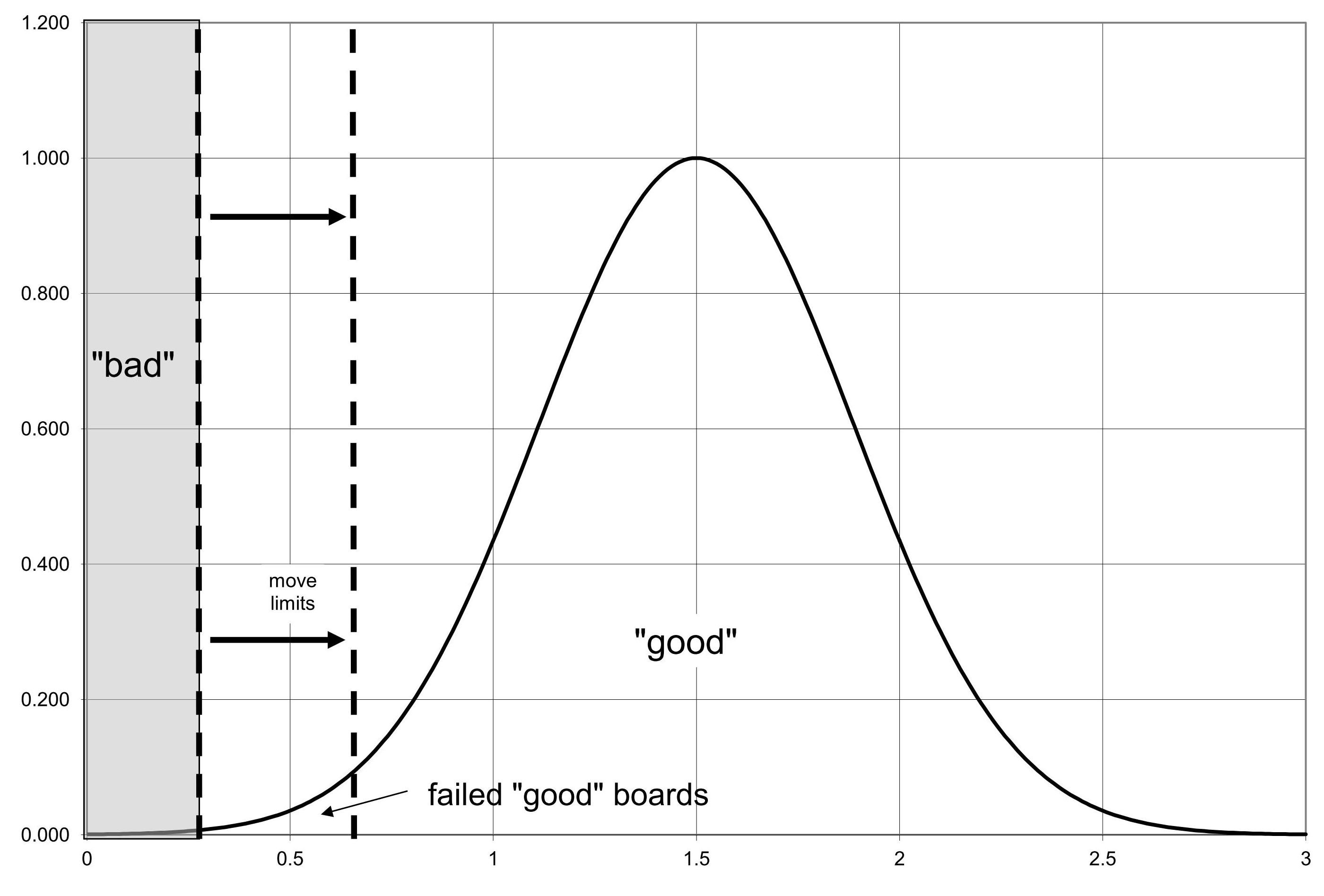 Tightening test criteria to avoid passing bad boards will of necessity fail good ones. (Source: Building an Intelligent Manufacturing Line, page 17)
Developing a strategy to test printed-circuit boards, for example, requires establishing test conditions to strike a balance between allowing bad boards to pass (“escapes”) and marking good boards as bad (“false failures”), as the figure (from Building an Intelligent Manufacturing Line) illustrates. Although the figure states the case clearly, setting pass/fail criteria depends on many tangible and less tangible factors described in the relevant text, all requiring analysis beyond a binary “yes” or “no.” A remote oral event such as a webinar would show the figure and explain the relationships among the factors involved, trying to explore the nuances that affect “pass” or “fail” decisions. But unless attendees take copious notes that they understand without prompting from the presenter, they will likely miss some of the finer points of making that decision and forget some of the important points later on. A conventional on-site seminar works better because the presenter can “read” the audience and adjust the information conveyed on-the-fly based on comments made and questions asked. Still, time constraints invariably preclude including more than a subset of the information that an article, white paper, book or other source material contains. Unless people record the audio and retain the slide show, portions of the discussion will fade with time.
A written discussion can provide a much more comprehensive picture, addressing the ultimate question, “What are you making?” as well as production levels and lot sizes, likely failure rates, product lifetimes and so on.
Written words require deft, gifted editing so that the finished product communicates exactly what the author intended. The effort ranges from correcting misspelled words and incorrect grammar to reorganizing ideas that occur to an author out of order from the way an audience can understand and internalize them. An author who rereads text that expounds on a complicated point may regard that explanation as adequate because he or she already understands what the narrative is trying to convey. A random reader unfamiliar with the subject matter, however, may find the discussion somewhat opaque.
Yet, reading gets less respect today than it did a generation ago. The preponderance of social media to convey information leaves an impression of imprecision and impermanence. Scientific laws appear less immutable without a thorough explanation that recipients can reread and digest at their own pace and in their own way, and a 140-character Tweet proves woefully inadequate. The problem is twofold. People read less because they deem it less efficient than seeing a presentation. And fewer people write well because no one considers it the critically important skill that it is.
True comprehension depends, as it always has, on a combination of communication techniques. A verbal presentation can more easily break the ice for audience members unfamiliar with concepts, strategies and basic principles. Written material supports and amplifies the concepts to allow people to delve more deeply into the subject. You need both to supply a more complete answer.
Reference:
Stephen F. Scheiber, Building an Intelligent Manufacturing Line, Quale Press, 2001.