
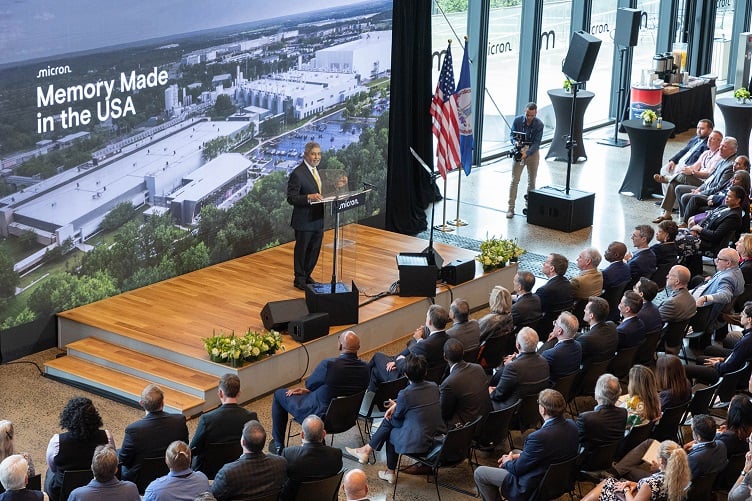
Micron Technology Inc. has started manufacturing its 1-alpha (1α) DRAM at its Manassas, Virginia, fab, an effort the company claims is a significant step toward expanding U.S. memory chip production.
Micron claims the 1α DRAM node is the most advanced memory technology produced in the U.S. and is suited to long-lifecycle memory for applications like automotive, defense and aerospace, industrial, networking and healthcare devices.
Micron’s $2 billion investment in the expansion and modernization of its Manassas fab that allowed for the 1α DRAM node to be produced is part of the company’s $200 billion investment plan to expand memory manufacturing and R&D in the U.S.
Some of the investments include:
- Two leading-edge memory fabs in Idaho
- Up to four leading-edge fabs in New York
- Advanced HBM packaging capabilities
- R&D for future innovation
Micron said it has broken ground on the memory fab in New York in January with initial ground preparation activities ahead of plan. Micron said it expects initial wafer output at its first Idaho fab in mid-2027 with ground preparation already started for the second Idaho fab.
These plans will create about 90,000 jobs, Micron added.
1α technology
The 1-alpha DRAM is designed for AI applications on flagship smartphones.
The technology offers a speed grade at 10.7 Gbps and enables a longer battery life with 20% power savings.
Additionally, the 1γ-based LPDDR5X is the first mobile memory to use advanced extreme ultraviolet (EUV) lithography and builds on the February sampling of the 1γ-based DDR5 memory for next-generation microprocessors for data centers and enterprise segments. It also uses high-K metal gate technology for improved transistor performance and EUV lithography for enhanced bit density.
Micron said it evaluated mobile AI response times from large language model Llama 2 based on the 1γ (1-gamma) node-based LPDDR5X memory compared to its 1β (1-beta) LPDDR5X’s 7.5 Gbps bandwidth. The company found:
- 30% faster responses in location-based restaurant recommendations.
- 50% faster results when translating voice inquiries.
- 25% faster responses when requesting car purchase recommendations.
