
Given that technology permeates nearly every segment of our lives, I cannot imagine a more difficult time for those who are not at all technology savvy. The digital divide represents the gap between those with ready access to computers and the internet and those without it. However it is more than that. On one hand, the mobile phone and then the smartphone have done much to close the gap, but on the other, the sheer speed of technology is counteracting the gain and widening it.
- More or less bandwidth
- More or less in the way of skills
- Availability of immersion
- The economic means to access technology or not
- Knowing what to do with information once accessed
- An infrastructure that is accessible, convenient or inconvenient
- Political interference in access
- The willingness to move beyond the entertainment value of the internet
And more…
How Wide Is the Gap?
When the digital divide means so many different things to individuals and businesses, how is it possible to begin to measure the span of it? In the past, researchers and interested parties would look at the number of internet subscriptions or the number of digital devices in use. It is also possible to measure bandwidth per person in Kbit/s, whereby the divide fluctuates as soon as new technology is introduced and early adopters engage, and then closes as it becomes mainstream and the underlying price comes down. To continue to measure, however, it helps to look at different layers of the divide. Typically a digital divide results from poverty and limited resources
that inhibit the purchasing and even use of new technologies.
Many would argue that while access to the internet is the main consideration for measuring where the digital divide might be at any given time, a more important or accurate consideration should be access to information and communication technologies and the media. Access is merely one aspect—but just as important are such things as connection quality, services offered and, especially, cost.
No matter how you look at the divide, however, the chasm does represent the difference between those that have and those that have not.
Those That Have Not—Who Is at Risk?
Many factors are at play when looking at those that are on the wrong side, or distant edge, of the digital divide. According to a State of Connectivity 2015 study, published by Facebook, one of these factors is cost.
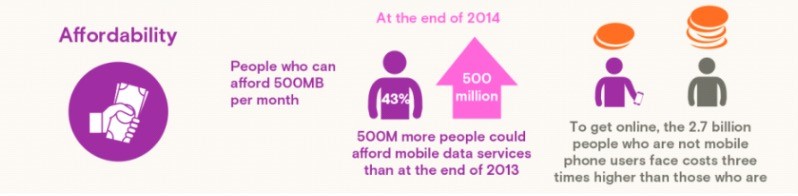 Figure 1. There is a serious disparity between mobile phone users and those who are not regarding cost of online access. Source: Facebook NewsCost was not the only barrier for the 4.1 billion people. Three other top reasons include (1) availability, or the proximity to access infrastructure; (2) a reason to want to access it; and finally, (3) the capacity to comprehend, skills required to access and maneuver, and cultural acceptance for the individual.
The study indicates that at the end of 2015, 3.2 billion people were online compared to 3 billion in 2014. The growth is attributable to more affordable data and increasing global incomes. Over the past decade, connectivity grew by approximately 200 to 300 million individuals annually. Unfortunately 4.1 billion people were still not accessing the internet in 2015. UNESCO reports global literacy rates and population figures for illiterate adults and youth. In 2013, 757 million adults and 115 million youths could not read or write a simple sentence. While these numbers are gradually dwindling, this population is the most severe example of the divide.
When lack of access to the internet is discussed, it is typically done so within the context of the underprivileged. However more credence is being paid to the fact that the digital divide today really has more to do with the fact that technology is used to accomplish so much more in our busy lives, including shopping, home automation and transportation scheduling, to name a few. When technologies are delivered that are intuitive, it is like a three-year-old learning to play games on a computer. By the time you figure out the rules, the child has mastered it. When we remember to add sufficient intuitive features, it is no longer intimidating to use technology. The plug-and-play aspect of it brings the timid along rather than alienates them.
 Figure 2. Global Literacy Rates and Illiterate Population in 2013. Source: UNESCO Institute for Statistics
The plight of the rural resident and his or her access to technology was a major concern that is effectively beginning to be addressed. Power lines, satellites and even the potential to use drone technology are all remote-internet enablers, and major technology corporations recognize the long-term financial benefits of enabling these users.
There is still a divide between rich and poor. Children in low-income school districts have likewise poor access to technology, which will hinder them from absorbing the skills that are crucial to their own success and, potentially, to that of their communities. The statistics may surprise you:
- A 2012 Pew report titled “Digital Differences” claims that 62% of people in households earning less than $30,000 a year used the internet, while usage of those earning $50,000–74,999 is approximately 90%.
- Only 49% of African-Americans and 51% of Hispanics have high-speed internet at home, versus 66% of Caucasians.
- The Federal Communication Commission’s Broadband Task Force reported as far back as 2009 that 70% of teachers assign homework requiring access to broadband, and 65% of students used the internet at home to complete their homework.
- Only 4% of college graduates do not use the internet, while 41% of those without a high school degree do not use the internet.
- Age plays a role: 44% of those over age 65 do not go online.
Those who have school-age children represent the major challenge. Five million households have homework to attend to in some form. Children must do it at school, find internet access outside of the home or, what happens all too often, they do not turn it in.
The elderly represent a special challenge. Over the past several decades, as technology in the form of digital devices—including VCRs, microwaves, TVs and so forth—appeared on the scene, typically the elderly could be counted on to have perpetual 12:00 on their devices instead of the current time. While the use of technology among the elderly is on the rise, prompted by the desire to stay connected to family, they do and will continue to lag in use compared to younger users. Especially for this older demographic, intuitive plug-and-play solutions are paramount.
The Global Divide
The internet did not develop and evolve uniformly in the world. There is marked disparity between countries and their access and use of technology—representing the global digital divide. The results of limitations in access include low wages, lack of online commerce, lack of electronic services and inability to adequately research. There are two important aspects of the global variety. First, there is the educational and resource allocation needs. Second, there is a political aspect to maintaining and even encouraging a divide.
International programs, such as the One Laptop Per Child effort and MIT’s IMARA project, exist to provide residents of poor and isolated regions within developing countries resources to bridge the digital divide. In the case of the former project, a laptop is given to each child; it is designed to be a gateway to digital learning and internet access. The XO laptops contain features that are designed for the unique conditions that exist in remote villages. They use little power, have a sunlight-readable screen, and automatically network with other XO laptops to access the internet. Up to 500 machines share a single point of access.
The latter is an outreach program designed to bridge the global digital divide. Its goal is to define and implement long-term solutions to increase the availability of educational technology and resources to domestic and international areas in need. MIT volunteers who train, install and donate computer setups staff the target regions. The recipients are located in several communities from Boston to the Middle East.
Companies such as Facebook readily grasp the power of social media. More than 75% of its users are outside of the U.S. Social media can be used as a tool to bridge the global digital divide. However U.S. technology companies, Facebook included, must step gingerly around the world as U.S. content is seen as inappropriate for consumption by certain countries. Recently such countries as India, China and Iran denied access to certain websites to attempt to eliminate the influence of foreign culture.
China, the U.S. and Japan host 50% of the globally installed bandwidth potential. The U.S. lost global leadership in 2011 to China, which hosted in excess of twice as much national bandwidth potential by 2014.
Will It Improve or Worsen?
The digital divide is evolving. In the past, it was developing countries and economies, rural/remote residents and businesses, small organizations and those with less income and education that made up the digital divide. Today it is old-guard organizations that are not ready to move on, especially in how things are done, as well as organizational leaders and senior professionals lacking sufficient technology appreciation and know-how.
Globally STEM jobs are on the rise, requiring a science, technology, engineering, or math-related degree. However, according to a study conducted by the Georgia Institute of Technology and the International Telecommunication Union, less than a third of young people in the world are digital natives—those who have spent at least five years actively using the internet. That there is a divide, or a disconnect, is not doubted. But how to fix it quickly is unclear.
