
As we all know by now, the material graphene has the potential to improve a plethora of research and consumer fields.
Graphene, just one-atom thick, is the thinnest substance capable of conducting electricity. It is also very flexible and is one of the strongest known materials. For years now, scientists and engineers have been working to adapt graphene for flexible electronics, but this has been a challenge because its sheer resistance causes it to dissipate large amounts of energy.
Four years ago, Dr. Monica Craciun and Professor Saverio Russo, along with their teams of researchers from the University of Exeter’s Centre for Graphene Science, discovered that sandwiched molecules of ferric chloride between two graphene layers make a whole new system that is more than a thousand times a better conductor of electricity than graphene. So far it is the best-known transparent material able to conduct electricity.
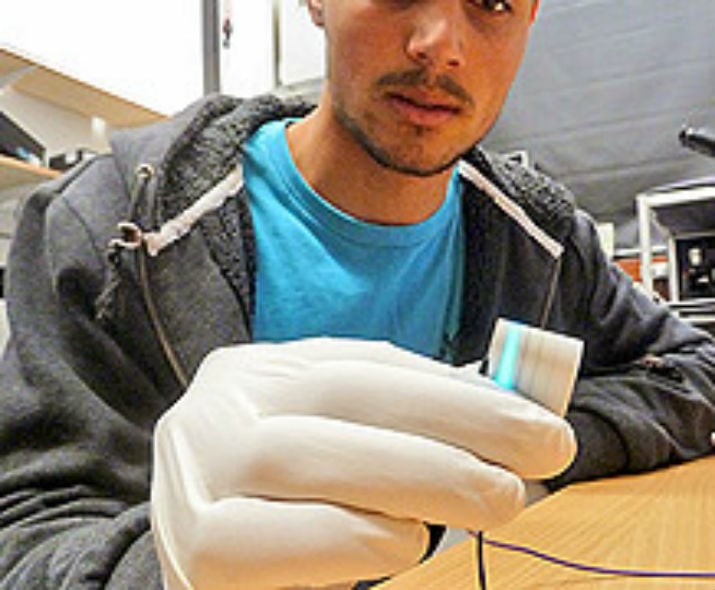 GraphExeter is a material adapted from the "wonder material" graphene. (Image Credit: University of Exeter)That same team has now discovered that GraphExeter is also more stable than many transparent conductors.
The researchers are using GraphExeter, the material adapted from graphene, in order to improve future large, flat and flexible lighting. GraphExeter shines light on a future filled with flexible lighting devices.
By using GraphExeter, the most transparent, lightweight and flexible material there is to date for conducting electricity, instead of pure graphene, the team was able to increase the brightness of flexible lights by up to almost 50%.
The research has also shown that using GraphExeter makes the lights 30% more efficient than existing examples of flexible lighting that are based on commercial polymers.
The team believes that the breakthrough could improve the viability of next-generation flexible screens, which could be used for display screens, smartphones and wearable devices such as electronic clothing.
“This exciting development shows there is a bright future for the use of GraphExeter in transforming flexible lighting on a mass scale, and could help revolutionize the electronics industry,” said Dr. Saverio Russo, University of Exeter physicist. “Not only are lights that utilize GraphExeter much brighter, they are also far more resilient to repeated flexing, which makes ‘bendy’ screens much more feasible for day-to- day goods such as mobile phones.”
While strides have been made with flexible screens, bringing increased functionality, the technology is still in the beginning stages of development. The size of the screens is limited by the materials used for mass production, which can cause a visible gradient of brightness as the size of the screen increases.
By replacing graphene with GraphExeter, the team was able to create a lit screen that showed a far greater and more consistent light than has previously been possible. The screens were also more resilient when they encountered continuous flexing, which means they would have a longer shelf-life before needing to be replaced.
“The next step will be to embed these ultra-flexible GraphExeter lights on textile fibers and pioneer ground-breaking applications in healthcare light therapy,” said Dr. Monica Craciun, also from the University of Exeter.
