University of Cambridge researchers have developed two new systems for driverless cars that can identify a user's location and orientation in places where GPS does not work well and identify the various components of a road scene in real time on a regular camera or smartphone – in essence performing the same job as sensors that cost tens of thousands of dollars.
The systems cannot currently control a driverless car, but the ability to make a machine 'see' and identify where it is and what it's looking at is a vital aspect of autonomous vehicle development.
The first system, called SegNet, can take an image of a street it hasn't seen before and classify it by sorting its surrounding objects into 12 different categories like roads, street signs, pedestrians, buildings and cyclists, all in real time. It can work with light, shadows and night-time environments. Currently the system is capable of labeling more than 90 percent of pixels correctly. According to the researchers, previous systems using expensive laser or radar based sensors have not been able to achieve this accuracy.
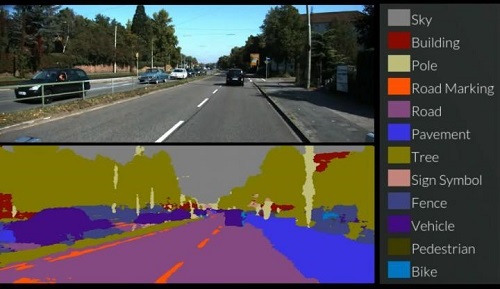 This is an example of SegNet in action. (Source: Alex Kendall)
People can test out this portion of the system right now on the SegNet website and upload an image or search for any city or town in the world. The system will label all of the road scene’s components.
Instead of expensive sensors, which recognize objects using radar and LIDAR, SegNet learns by example. The system was “trained” by a group of Cambridge students, who manually labeled every pixel in 5000 images. Once they completed the labeling process, the researchers took another two days to complete the training process. "It's remarkably good at recognizing things in an image because it's had so much practice," says Alex Kendall, a PhD student in the Department of Engineering. "However, there are a million knobs that we can turn to fine-tune the system so that it keeps getting better." So far, SegNet was trained in highway and urban environments, but it will continue learning to achieve the same results for rural, snowy or desert environments.
Although the team acknowledges that SegNet is not yet ready to take on control of cars, it could be used as a warning system (like anti-collision technologies) in the meantime. "Vision is our most powerful sense and driverless cars will also need to see," says Professor Roberto Cipolla, who led the research. "But teaching a machine to see is far more difficult than it sounds."
The other system the Cambridge researchers have designed is a localization system that is similar to SegNet and allows users to determine orientation from a color image. The team says that this system is far more accurate than GPS and works in places where GPS does not (indoors, in tunnels, or in cities where a reliable GPS signal is not available).
The team tested the technology along a highway in central Cambridge, and found that it is able to determine both location and orientation within a few meters and a few degrees, which is far more accurate than GPS. "Work in the field of artificial intelligence and robotics has really taken off in the past few years," says Kendall. "But what's cool about our group is that we've developed technology that uses deep learning to determine where you are and what's around you. This is the first time this has been done using deep learning."
Since the technology is not quite ready for driverless vehicle use, the students see it being used in robotics – something like a robotic vacuum cleaner— until is fully developed.