
Targeting undergraduate college-level chemistry lab settings, Beaverton, OR-based Vernier Software & Technology announced a flash photolysis spectrometer that the company calls the first of its kind designed specifically for educational use. Vernier also introduced a pressure sensor and conductivity probe.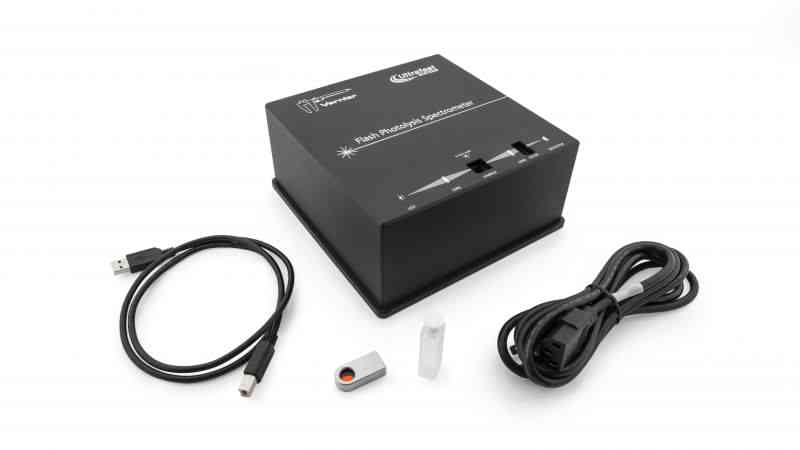 The Vernier Flash Photolysis Spectrometer is a compact tabletop instrument for demonstrating the fundamental principles of chemical kinetics.
The Vernier Flash Photolysis Spectrometer is a compact tabletop instrument for demonstrating the fundamental principles of chemical kinetics and photochemistry during experiments that involve excited-state dynamics, triplet-decay analysis, and time-resolved phosphorescence. It includes a 600 nm filter that measures the absorption and emission changes over time of a photo-excited sample at a single wavelength. The Vernier Flash Photolysis Spectrometer also includes free software and downloadable experiments.
Priced at $5,400, the Flash Photolysis Spectrometer is, in Vernier's estimation, about one-fifteenth the cost of other instruments supporting transient absorption spectroscopy.
The Pressure Sensor 400 (priced at $189) measures absolute pressures from 0 to 400 kPa and operates over the -40°C to 125°C temperature range. It supports physical and analytical chemistry experiments, such as approximating the adiabatic expansion of a gas, Charles' law experiments, and gas law investigations.
Vernier's Platinum-Cell Conductivity Probe ($149) lets high school and college chemistry students explore the various properties of conductivity in a wide variety of solutions such as stronger acids and bases, as well as non-aqueous solutions. Students can also to explore the dependence of conductivity on temperature. The 2-cell, glass-insulated platinum sensing element and epoxy body of this electrode ensures greater chemical compatibility and accuracy. With a conductivity range of 0 to 2000 µSiemens/cm, the probe offers ±40 µS/cm accuracy and operates over the 0°C to 80°C temperature range.
