
An underwater robot that adapts according to mission needs in real time has been developed by a team of researchers at Purdue University.
The patent-pending robot, which promises to improve ocean research, underwater infrastructure inspection and search-and-rescue tasks, features different travel technologies that enable it to conserve energy, to travel farther, to follow currents, to reposition or to escape from a restricted region, based on mission.
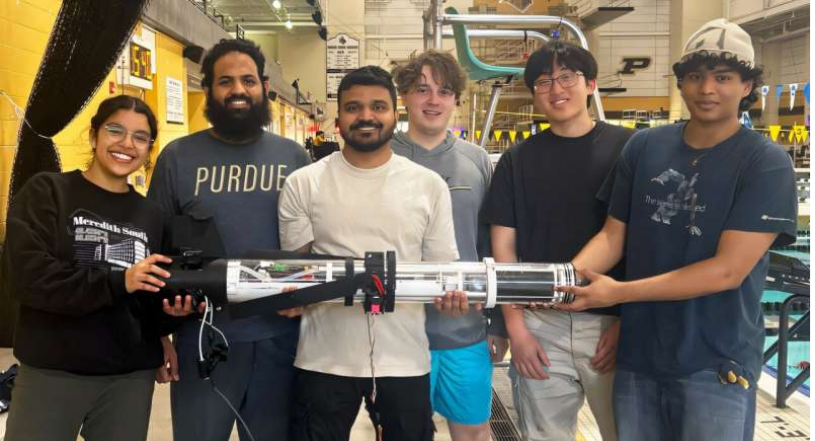 Source: Purdue University
A significant challenge in underwater robotics is that different missions demand different locomotion — either passive drifting, buoyancy-driven gliding or thruster-driven propulsion, the team noted.
However, the team has merged all three locomotion modes into one underwater platform. Depending upon the mission, the robot can choose the appropriate mode, thus making the platform ideal for applications such as ocean and lake monitoring, current and flow mapping, inspection of underwater structures, exploration beneath ice shelves, environmental sensing and distributed underwater data collection.
"A purely drifting platform may be carried by currents but unable to actively navigate to a target or recover from an undesirable path," the team said. "A purely gliding platform may have good endurance but may struggle in confined or complex environments. A purely thruster-driven vehicle may maneuver well but may consume power quickly, limiting mission duration."
The robot is designed to overcome the higher costs, limited mission times and coverage, and risk of getting trapped associated with using specialized underwater vehicles. It combines three locomotion modes in one platform: drifting with water currents, gliding for efficient long-distance travel and thruster-powered movement for active maneuvering.
The system coordinates buoyancy control, internal mass shifting, foldable wings and propulsion to switch between modes. Pool tests confirmed that these subsystems work together and demonstrated all three intended movement behaviors. Mode switching is currently manual, but researchers plan to automate it and further evaluate the robot’s energy efficiency, endurance, maneuverability and control accuracy.
