
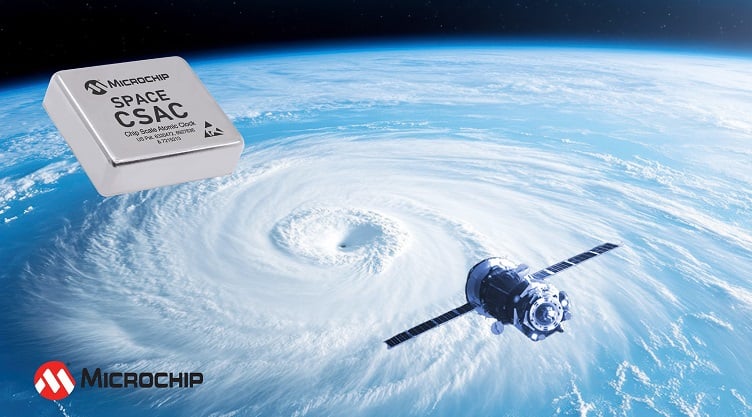
Demand in the so-called new space sector is growing as companies seek to accelerate satellite-to-cellular communications (SATCOM), alternative navigation and Earth imaging applications.
Microchip Technology is expanding its atomic clock portfolio as the demand for radiation-tolerant electronic components is growing in parallel.
Called the Space CSAC-SA65, the device extends radiation tolerance to at least 30 kRad and operates in extended temperature ranges from -40° C to 80° C, Microchip said.
The company bills the atomic clock as a low power, less than 120 mW, and compact alternative to traditional radiation-hardened timing solutions that can reduce the size, weight, power and cost of satellites and other orbital platforms.
“By enabling one of the lowest power atomic clocks to thrive in extreme conditions, even the smallest CubeSat can now fly with atomic accuracy,” said Randy Brudzinski, corporate vice president of Microchip’s frequency and time systems business unit. “The Space CSAC-SA65 brings atomic-clock performance to applications where size, weight, power and cost are tightly constrained, helping developers maintain synchronization and timing accuracy even when external timing references are unavailable.”
The Space CSAC-SA65 is manufactured as a commercial off-the-shelf (COTS) product using rad-tolerant commercial electronic components designed for Low Earth Orbit (LEO) missions including:
- Satellite timing and frequency control
- Satellite clock reference
- Assured positioning, navigation and timing
- Satellite cross-linking
