
As manufacturers shift to electric forklifts, automated guided vehicles (AGVs), and other material handling equipment, infrastructure-led electrification strategies are essential.
Two important considerations for warehouse fleet electrification include:
- High-efficiency battery chargers, which allow engineers to charge vehicles faster or reduce the equipment’s total electrical load on existing facility power systems.
- Multi-chemistry and multi-voltage battery chargers provide mixed fleets with greater scheduling flexibility and reduced downtime.
This article explores how infrastructure-led, rather than fleet-led, electrification strategies help maximize electric equipment uptime and performance.
What are infrastructure-led charging strategies?
Traditional fleet-led infrastructure strategies focus on the electric vehicle and its battery. However, these approaches limit electrification success as material handling fleets grow and become more complex. Today’s electric fleets are expanding while requiring near-continuous uptime to support busy operations across large production floors. They often include multiple vehicle types with different battery characteristics and chemistries. The increasing adoption of electric vehicles (replacing internal combustion-powered vehicles) is also impacting existing power availability and utility costs for many operations.
As fleets grow and complexity increases, fleet-led strategies can overlook important considerations. Charging infrastructure, operational flexibility and utility efficiency are all essential for a successful electrification transition. When equipment purchasing outpaces infrastructure planning, vehicles may sit idle waiting to charge, lose power mid-shift or require more power than a facility’s existing systems can provide.
Instead, infrastructure-led strategies improve electrification efficiency and vehicle uptime at a broader, facility level. These strategies require careful evaluation of available electrical capacity and distribution capabilities (transformers, switchgear, etc.). For design engineers, one important part involves selecting material handling equipment chargers that provide high energy efficiency and support mixed fleets.
How battery chargers impact total system efficiency
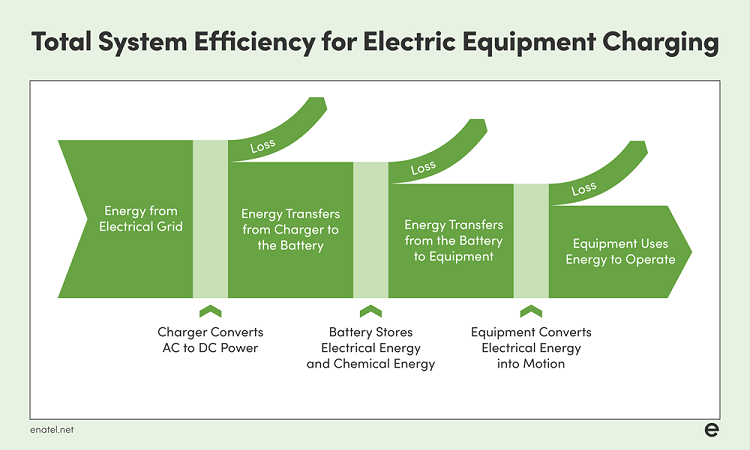
Charger efficiency is the first key consideration. Energy efficiency, or power conversion efficiency, describes how much input energy is converted into useful output. Inefficient battery chargers impact total system performance, particularly because they operate at an early stage in the energy conversion process. In general, the flow of energy through the system involves:
- Chargers converting incoming AC power from the electrical grid into DC power usable by the battery.
- The battery then converts the electrical energy to chemical energy to store. Later, the battery converts the chemical energy back to electrical energy to supply the material handling equipment.
- Motors convert electrical energy into lifting and motion.
Charger inefficiencies in the first AC-DC conversion phase impact the rest of the downstream system. Low-efficiency chargers reduce the total energy available to the battery and equipment, while high-efficiency battery chargers maximize usable energy transferred.
What are high-efficiency industrial battery chargers?
Charger efficiency is measured by manufacturers as ‘peak efficiency,’ which refers to the highest efficiency a charger can achieve under optimal conditions. Real-world performance is generally lower depending on the battery voltage, supply voltage and charge profile.
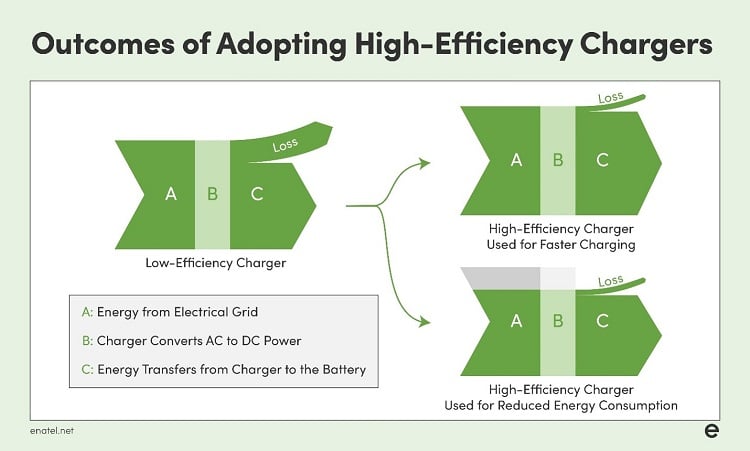
Typical forklift battery chargers may provide 80% to 91% peak efficiency. High-efficiency chargers can achieve up to 97% peak efficiency, meaning a smaller portion of input energy is lost during the conversion. The benefits of high-efficiency chargers include either increased uptime or reduced energy costs:
- Faster charging: High-efficiency battery chargers deliver more usable DC output for a given AC input. When supplied with the same amount of power from the grid, a higher-efficiency charger transfers more energy to the battery. The result is quicker charges, enabling equipment to get back into service faster.
- Energy costs savings: Alternatively, high-efficiency chargers can deliver the same energy output with less AC input. Less power from the grid results in utility cost savings. For example, upgrading a fleet of 30 48 V electric vehicles in the U.S. from an 85% to 97% peak efficiency charger could save up to $9,255 annually (assuming a charge of $0.20/kWh), though actual savings will vary based on duty cycles.
Depending upon the specific facility, engineers can determine whether pursuing faster charging or minimizing energy consumption is more beneficial. Manufacturers with 24/7 operations and complicated shift schedules may benefit from faster charging and increased equipment uptime. Manufacturers with limited power distribution capabilities or tight budgets may benefit from energy cost savings. In either case, an infrastructure-led electrification strategy should consider high-efficiency industrial battery chargers as one method to improve facility-level performance.
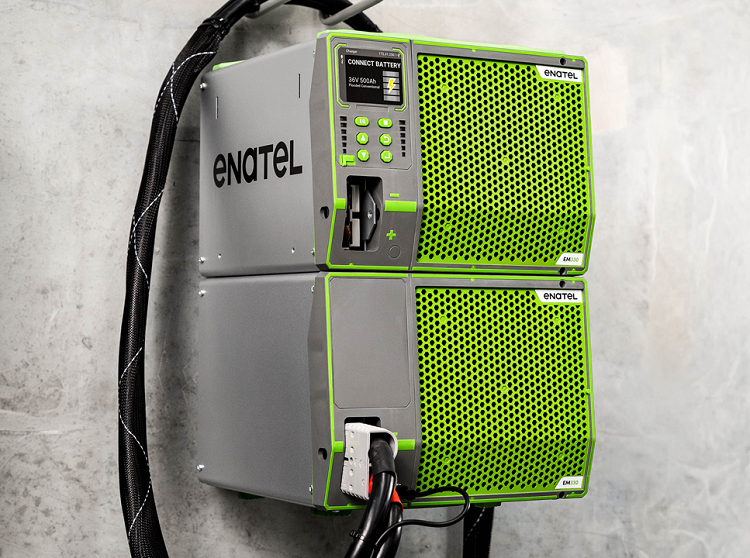 An Entatel battery charger that could be used to power electric warehouse vehicles like forklifts or AGVs. Source: Enatel
Why does battery chemistry flexibility in industrial battery chargers matter?
A second important consideration involves battery charger flexibility. Modern electric fleets are often mixed, incorporating a range of vehicle types with different operating voltages and battery chemistries (lithium-ion, lead-acid, etc.). Selecting a charger that supports only one chemistry can complicate charge scheduling and introduce engineering complexities. For example, vehicles may sit idle waiting to charge because available chargers are incompatible with their type of battery.
Industrial battery chargers designed for mixed fleets help reduce the likelihood of downtime and simplify vehicle scheduling. Some chargers, for example, support a wide variety of battery chemistries and voltages from 12 V to 48 V or 24 V to 96 V. When equipped with battery communication capabilities (CAN bus interfaces, battery monitoring modules, etc.), these chargers can automatically identify and charge distinct vehicle types without requiring separate operator input.
Multi-chemistry and multi-voltage chargers also increase capacity for future fleet growth. Many logistics and retail operations, for example, deploy additional forklifts to support operations across busy holiday periods. Flexible charging infrastructure supports new additions to fleets regardless of battery configuration or operating voltage.
Conclusion
As manufacturing operations adopt more electric equipment, engineers must adopt infrastructure-led rather than fleet-led electrification strategies. Evaluating existing electrical capacity and deploying battery chargers that meet fleet requirements are important steps.
High-efficiency battery chargers enable faster charging or reduce energy consumption. Chargers designed for mixed fleets reduce infrastructure complexity and improve scalability. By selecting efficient and flexible industrial fleet charging solutions, engineers can better prepare electric material handling fleets for the demands of modern manufacturing environments.
About the author
Anton Clark is senior product strategy manager at Enatel, where he shapes product strategy, industry partnerships and customer-focused solutions. He translates market insights into strategies that help customers navigate emerging technologies and evolving compliance requirements.
