
Logistics, manufacturing, healthcare, retail and more industries are all being impacted by the increasing use of automation. This change is being driven by ongoing technical advancements, such as the internet of things (IoT), machine learning and artificial intelligence, which are making automation more accessible and efficient. A new trend in mobile robot deployment has emerged to meet the dynamic needs of business and industry. Mobile robots were first employed in factories and warehouses to make handling items and moving them around easier. Now, mobile robots are essential to these industries since they help transport materials all throughout factories and warehouses. They are being used for simple things like tracking and customer service to more complicated things like moving cargo quickly.
What is a robot fleet?
Robotic fleets are groups of autonomous or semi-autonomous mobile robots (AGVs/AMRs) that work together to make operations like warehousing, manufacturing and shipping more efficient. The use of AI to manage fleets of robots has been growing. It has helped many robots that work in changing surroundings make better decisions, divide tasks, plan routes and work together. The concept of robot fleet management (RFM) emerged within this framework. RFM lets robots transmit important information including where they are, what obstacles they see, what work they are doing and what their priority is.
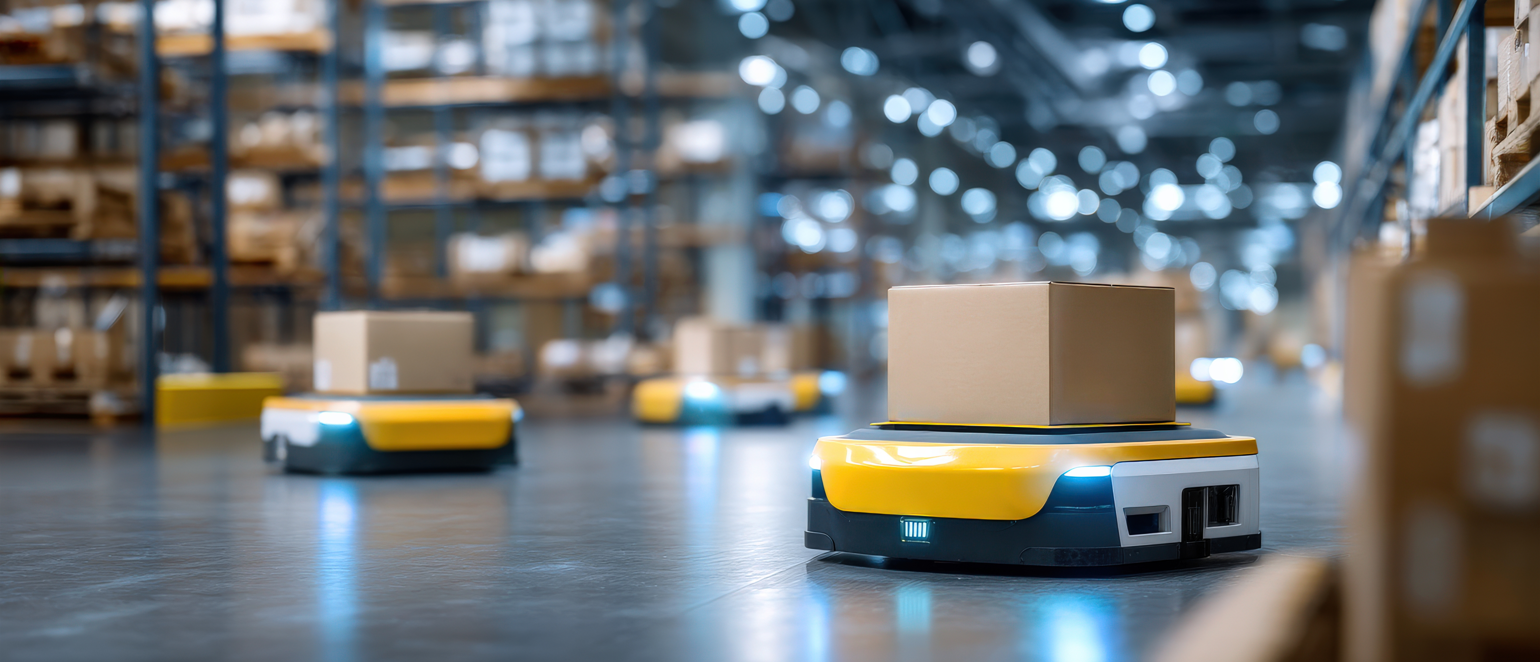 Source: Tiravad/Adobe Stock
How does a RFM system work?
An RFM system allows several semi-autonomous or fully autonomous robots to efficiently operate in a shared environment. Its first task is to distribute jobs to robots as per their availability, level of importance, location and battery life. Robots receive commands from path planning algorithms to find the best pathways after being given instructions, all the while continuing to adapt to new obstacles and their surroundings. By controlling traffic, avoiding collisions and optimizing mobility in densely populated locations like manufacturing lines or warehouses, the system also guarantees robot coordination.
The system communicates in real time, and its control architecture can be either decentralized or hybrid. Real-time data exchanged between robots allows coordination of operations and quick decision-making, including status, location and job progress. Additionally, to monitor general performance, the system includes safety features for interactions between humans and robots and can change routes and schedules on the spot. When combined, these features enable robot fleets to operate as a smart, scalable system that can efficiently manage complicated commercial and industrial activities.
Algorithms used in RFM
The following algorithms are mostly employed in RFM, offering strategies for task distribution and route planning:
· Adaptive Monte Carlo Localization (AMCL): AMCL is a probabilistic localization technique that integrates motion and sensor data to ascertain the robot's pose, proving especially effective in indoor settings.
· Dijkstra and A* (A-Star): Extensively utilized for determining the shortest path in graphs, making them essential in navigation and route planning applications.
· Genetic Algorithms (GA): These methods are employed to identify approximate solutions to intricate problems by navigating extensive solution spaces.
· Conflict-Based Search (CBS) and Traveling Salesman Problem (TSP): CBS effectively coordinates many robots, but TSP is crucial for route optimization when a robot must visit several locations.
· Dynamic-Window Approach (DWA): A local path planning technique that guarantees secure and seamless navigation by taking into account the robot's kinematics and environmental limitations in real-time.
· Contract-Based Task Allocation (CBBA) and Auction-Based Techniques: Auction-based methodologies employ bidding mechanisms to dynamically allocate jobs, enhance resource utilization and foster collaboration among robots in dynamic or competitive settings.
Challenges in RFM systems
The integration of several types of robots (AGVs versus AMRs) into a single control interface is a major challenge. To keep robots from getting stuck or obstructed in tight or congested environments, complex traffic management is needed. Optimizing productivity in large fleet management requires complex, real-time decisions about work allocation and routing.
Not being able to foresee when maintenance is needed leads to unexpected and costly disruptions, especially when relying on outside help. Maintaining high-quality, real-time data transmission becomes more complex as fleets expand, and a robust and reliable infrastructure is required to support expanding AI-driven systems. To understand and anticipate human behavior in communal settings, robots need sophisticated sensors that allow them to navigate around human workers. Inefficient robotic operation is sometimes caused by the absence of automatic and programmable doors and elevators in older structures like warehouses and hospitals.
Applications of robot fleets
A number of industries make use of robot fleets, including manufacturing, delivery, healthcare, urban areas, environmental research and warehouses. Warehouses can benefit greatly from RFM's ability to coordinate numerous robots, which in turn reduces waiting times and corridor congestion, allowing for faster product circulation. The manufacturing industry makes use of RFM to improve material flow throughout several stages of production by including intelligent route scheduling that takes job priorities, time constraints and environmental issues into consideration.
Conclusion
This trend toward mobile robotics in manufacturing is evidenced by the fact that the majority of robot fleet applications are still located in highly organized spaces like warehouses and factories. Nevertheless, there is an increasing demand for systems that can adapt to more unpredictable environments, such as exploration and inspection. Although there are certain shared characteristics among disciplines, the actual operational challenges can differ substantially. Future applications of RFM might extend to a broader variety of sectors, such as smart cities, healthcare and perhaps agriculture.
