
Researchers from the Chinese Academy of Sciences have developed a new humanoid robot that will support crop breeding.
According to its developers, the GEAIR (Genome Editing combined with AI-based Robotics) 2.0 can operate in complex crop environments without constant human control to autonomously perform tasks associated with hybrid pollination — including working among leaves and branches, navigating around plants and identifying flowers using its enhanced flower-recognition capabilities.
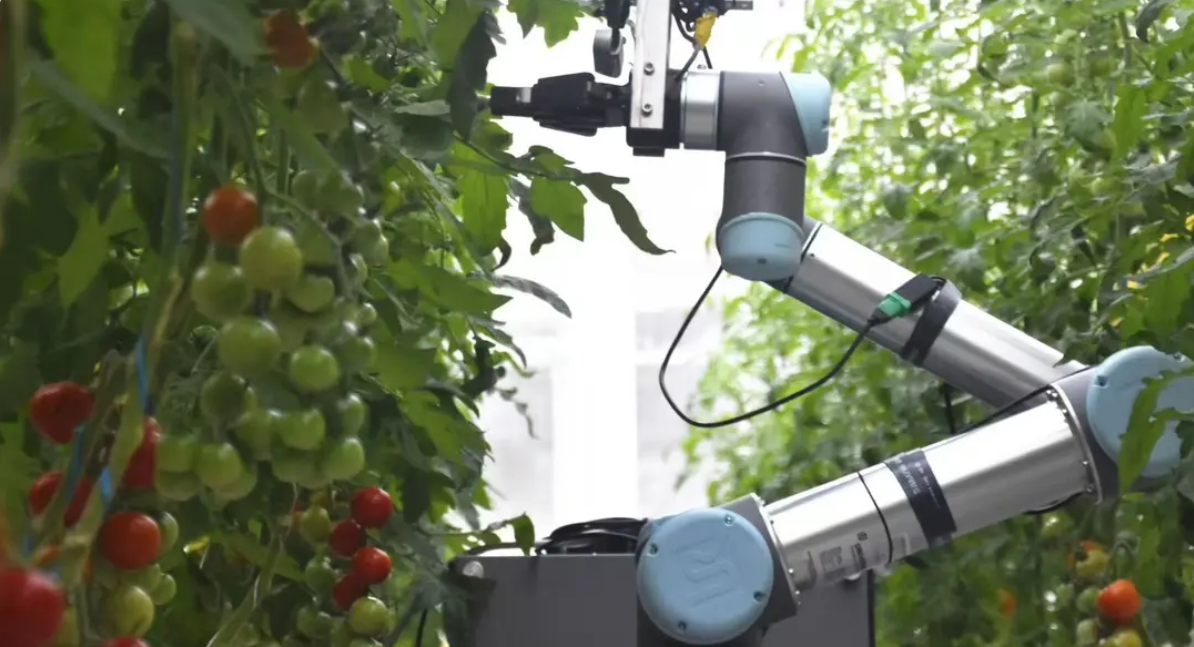 Source: Institute of Genetics and Developmental Biology under the Chinese Academy of Sciences
To automate hybrid pollination for crop breeding, the GEAIR 2.0 relies on a combination of robotics, artificial intelligence and biotechnology.
The GEAIR 2.0 humanoid robot features two arms, an upgrade from its predecessor’s single-arm design, enabling it to navigate dense crops more effectively and maneuver around leaves and branches. The robot has also improved its ability to identify the needle-sized stigma, the female reproductive part of a flower, increasing detection accuracy from 85% to 92.8%.
During its recent launch, GEAIR 2.0 demonstrated its tomato-pollination capabilities by holding a pollen tube with one hand while using the other to operate a pollination brush. Each pollination required less than 10 seconds, and a single brush dip in pollen was enough for approximately 50 pollination cycles.
GEAIR pairs gene-edited, male-sterile plants with AI-powered robotics to make automated pollination and plant breeding more efficient. Researchers modify plants to expose their stigmas, making the reproductive structures easier for the robot to locate.
Once deployed, the robot must navigate dense vegetation, avoid leaves and branches, and precisely locate each stigma before depositing pollen. Researchers say this could allow it to perform repetitive breeding tasks for longer periods than human workers and operate across different times of day and weather conditions.
The team explained that automating pollination could reduce the need for manual labor, lower breeding costs and make the pollination process more efficient.
