
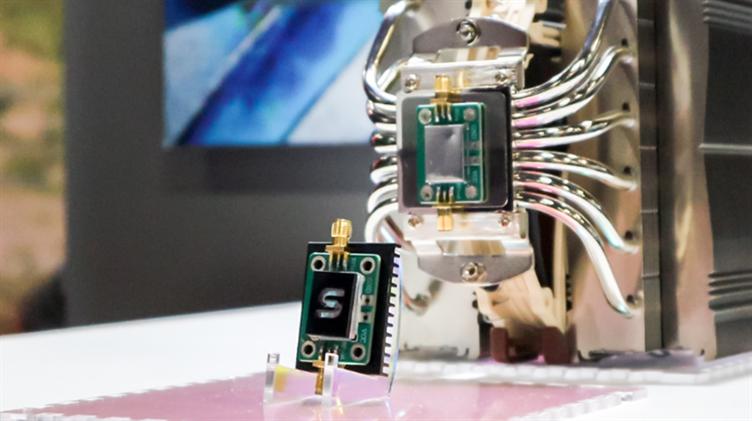
For decades, Moore's Law has governed the evolution of electronics. As the size of transistors kept shrinking and their number on a chip kept growing, devices doubled in power every two years.
But Moore's Law, formulated by Intel co-founder Gordon Moore in 1965, has been hitting the limits of what is physically possible for some time now. Transistor sizes dropped to the level of individual atoms, and things simply no longer could be made any smaller as conventional physics “break down” at this level.
Yet, with the AI revolution underway, the world’s demand for computing power is virtually insatiable. The only option so far, said Joshua Western, CEO and co-founder of in-orbit manufacturing start-up Space Forge, has been to build bigger computing machines.
“We have pretty much hit the fundamental physical limits of silicon,” Western told GlobalSpec. “A great articulation of that is the introduction of the dual core processor as a way of getting more physical power by using more equipment.”
But Western and his colleagues think there is another way to take computing to the next level — by manufacturing novel, more efficient semiconductors in space.
Silicon, a mineral element with 14 protons in its core, has underpinned the electronics revolution of the late 20th and early 21st centuries since the 1950s. In its purified, crystalline form, silicon is nature’s best semiconductor, a material the ability of which to conduct electricity can be controlled by clever engineering.
Making materials in space
Better semiconductors have been known for decades. Compounds such as gallium nitride (GaN), silicon carbide (SiC) or gallium arsenide (GaAs) offer superior performance. But they are more difficult to manufacture and therefore more expensive. Space Forge and other proponents of in-orbit manufacturing think they can make such materials in space. And not just that. They say that those made-in-space varieties will be superior to the best produced on Earth, thus justifying the added cost of launching to space.
“Gravity has a profound impact on the production of these compounds,” Western said.
Semiconductor compounds are produced by depositing vaporized precursor chemicals onto substrates in vacuum-filled chambers at very high temperatures. In the presence of gravitational forces on Earth, this growth is uneven due to convection processes inside the reactor, explained Western.
Additionally, the best vacuum generated in tightly controlled chambers on Earth can never eliminate all the possible impurities that could spoil crystal structures and limit the performance of the semiconductors manufactured from those materials. Space offers not only the absence of gravity, but a much purer vacuum; hence providing the possibility to make better performing semiconductors.
 SpaceForge is looking at in-orbit manufacturing to make materials in space. Source: SpaceForge
Decades of research
The idea to make semiconductors in space has been around since the 1970s when NASA conducted experiments aboard its SkyLab space station. According to a study published in the journal Nature in 2024, over 160 semiconductor crystals had been grown in microgravity between 1973 and 2016. Around 86% of those crystals displayed larger and more uniform structures than their earthly counterparts and demonstrated superior performance.
“In almost all cases, microgravity allows a more perfect crystalline form,” Anne Wilson, a professor of Chemistry and Biochemistry at Butler University in Indianapolis and corresponding author of the Nature study, told GlobalSpec “This allows for the enhanced properties.”
Those more uniform and purer crystals have fewer defects, which improves electron mobility. Steve Putna, the associate vice chancellor and director at the Semiconductor Institute at Texas A&M University, said that such semiconductors could be up to 20% to 40% more efficient compared to “Earth-grown counterparts with similar architectures.”
A report titled "Semiconductor Manufacturing in Low-Earth Orbit for Terrestrial Use" compiled by NASA in cooperation with Stanford University and released in 2023 stated that crystals of semiconductor cadmium telluride grown in space could increase the yield of solar panels by 150%. The researchers behind the report encouraged the electronics industry to look for ways to harness those benefits.
Simply better
The possible use cases for these crystals vary from AI data centers to electric vehicles. Western estimates that space-grown semiconductors could enable energy savings of up to 50% in large infrastructure installations such as 5G towers. The purity and the structure of the crystals, he added, is directly related to the thermal performance of the semiconductor, meaning the electronic components will require much less cooling, resulting in lower energy consumption.
 An image of the first plasma generated on SpaceForge’s ForgeStar1. Source: SpaceForge Western said that made-in-space semiconductors offer an opportunity to humankind to continue benefiting from the AI revolution that is currently underway while getting the industry’s environmental footprint under control.
“If we want to solve some of the most pressing issues that we face with respect to the consumption of natural resources, we need to find a way to do things more cheaply,” Western said. “In-space manufacturing is the first opportunity that we have to directly redress some of those imbalances by still improving humanity’s position but without the further detriment to the environment we inhabit.”
Still, making chips in space costs money. Getting 1 kilogram into orbit with SpaceX Falcon 9 currently comes with a price tag of under $1,500. Space-grown crystals also need to be safely returned to Earth. Currently, the only vehicle capable of bringing cargo from space to Earth is SpaceX’s Cargo Dragon capsule, and demand for its services is high. Returnable satellites are being developed, including by Space Forge, but this requires time to develop as well as funding. Space Forge is currently testing an orbital semiconductor foundry satellite but only expects to bring the first batch of made-in-space materials back to Earth with its next mission in 2027 at the earliest.
Western admits that manufacturing large quantities of semiconductors in space, despite their superb performance, is unlikely to make economic sense any time soon. Instead, the company wants to produce seed crystals, which would be returned to Earth and grown further in Earth-based foundries. Just 1 kilo of semiconductor crystals can sprout into tons while retaining the otherworldly qualities, Western said.
“Space gives you the kickstart to your process and a better base line for crystal growth,” Western said. “Using a space-grown seed will mean that the material grown back on earth on top of it will be of better quality than what can be currently achieved.”
The quality and purity of the structure would gradually decline, he admitted, but the material will retain its superior qualities compared to Earth-seeded counterparts for multiple generations.
Optical fibers
Semiconductors are one of several kinds of products that could benefit from a space make-over.
According to Paul Tilghman, the CTO of California-headquartered Voyager Technologies, which recently patented a new method for growing crystals in orbit, space is also a perfect environment to grow next generation fiber-optic materials that could speed up data centers and lead to breakthroughs in AI computing. The key to that, he said, are the larger crystal sizes that are possible to achieve in the absence of gravity.
“On Earth, the forces of gravity are pulling down on the crystal itself and you end up with breakages once you get beyond a certain size,” Tilghman told GlobalSpec. “As a result, a terrestrial crystal can be something like 2,500 cubic microns whereas the process that [we want to use in space] can create single crystals up to 20 cubic millimeters. That’s a factor of 5 to 8 million times larger in terms of crystal size.”
Voyager, which plans to test its new technique at the International Space Station later this year, expects the crystals to lead to massive improvements in data center technology, introducing a new generation of optical switches that allow much greater amounts of data to be packed into every single fiber.
Previous experiments have shown that made-in-space optical fibers, such as the heavy metal fluoride glass alloy ZBLAN, transmit light up to 100 times better than conventional silica-based optical fibers made on Earth. Other companies like Fiber Optics Manufacturing in Space, Made In Space and Physical Optics Corp. have previously produced ZBLAN on the International Space Station.
Although some critics remain skeptical about the proposition, some analysts estimate the in-orbit manufacturing industry could be worth $30 billion in the next decade.
