
Researchers at Chemnitz University of Technology (TU Chemnitz) have created a new generation of autonomous microrobots that can communicate, respond and work together in aqueous environments.
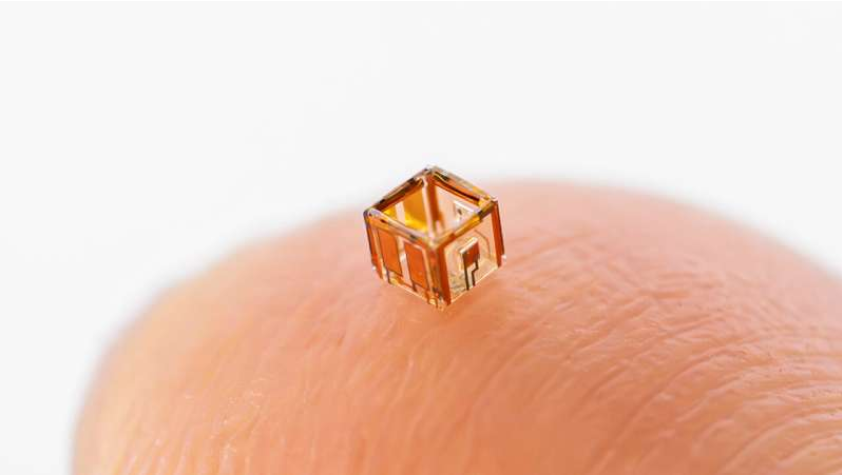
Dubbed smartlets, the mircrorobots, which are just a millimeter in size, are integrated with onboard electronics, sensors, actuators and energy systems and are capable of receiving and transmitting optical signals, responding to stimuli with motion and exchanging information with other nearby microrobots.
 Source: Jacob Müller
According to their developers, the smartlet microrobots are powered by integrated photovoltaic cells, controlled by tiny microchips and are capable of optical communication via embedded micro-LEDs and photodiodes.
The microrobots were built using a flexible origami-inspired approach, based on smart multilayer patterned materials, which enable the flat electronic system to autonomously roll and fold up into a minute scroll-adorned hollow 3D cube, featuring interior as well as exterior functionality. The team revealed that this opens up the extra surface space necessary for each cube to transport its own solar energy harvester, computational logic and an optical signaling system, as well as interacting external faces and inboard locomotion.
When submerged in water, the smartlets can reportedly move up and down via buoyancy forces produced by bubble-generating engines that fill the hollow interior of the devices with gas. Likewise, the smartlets can emit pulses of optical signals to broadcast instructions to other nearby smartlets.
The team explained that this setup allows for multi-robotic interactions in water, such as stimulus-driven movement, synchronization and coordination among several smartlets. When one unit receives a light signal, for instance, that smartlet can decode that information using its onboard processor, thus prompting a coordinated motion or behavior in others.
"The idea of using light as both energy and information opens up a compact and scalable way to create distributed robotic systems," the researchers added.
To accomplish this, the smartlets use a "wireless communication loop" that does not require external cameras, magnets or antennas.
Rather, optical messages are deciphered locally on each robot via custom-coded logic stored on their microchips. Specifically, the smartlets rely on soft-bonding to origami-films to attach previously developed custom microscopic silicon chiplets, dubbed lablets.
The smartlets have potential applications such as monitoring water quality, performing minimally invasive medical diagnostics, probing confined biological environments or used in soft robotics, autonomous inspection systems or distributed sensing networks.
An article detailing the smartlets, “Si chiplet–controlled 3D modular microrobots with smart communication in natural aqueous environments,” appears in the journal Science Robotics.
For more on the smartlets, watch the accompanying video that appears courtesy of TU Chemnitz.
