Could the U.S. government become Intel’s largest shareholder? A rumored 10% stake in the American chipmaker signals a potential new shift toward state-driven tech investment, mirroring strategies in China and Taiwan to secure America’s semiconductor future.
According to multiple reports, the Trump administration is discussing converting some or all of Intel’s grants from the 2022 CHIPS and Science Act into equity in the company. The goal would be to shore up the beleaguered semiconductor giant, which has been struggling with its chip manufacturing platform as well as its financial situation.
Additionally, the stake would help in the Trump Administration’s push to bolster domestic U.S. manufacturing for everything from semiconductors to vehicles, to all types of goods and services. With the semiconductor supply chain shifting to more regional manufacturing due to geopolitical issues and the fallout from COVID-19, having a more resilient supply chain domestically will help offset any potential disruptions that happen globally. At least, in theory.
Intel has been awarded about $11 billion from the CHIPS Act including about $8 billion for domestic semiconductor manufacturing plans. If these funds were converted into common stock, this 10% stake would make Intel the largest U.S. stakeholder.
However, the stake is just in the discussion phase, and it is unknown if the U.S. government has approached Intel about the possible idea.
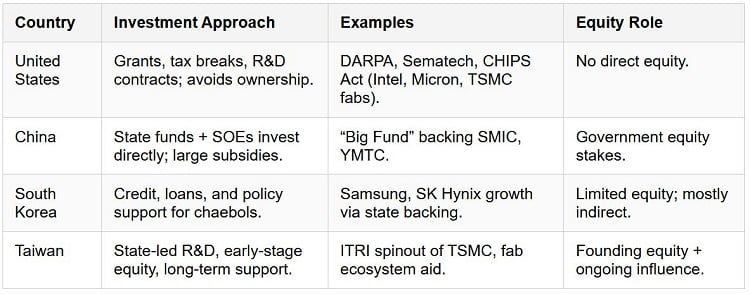 Original data. Chart generated by ChatGPT.
Similar model to Asian countries
If the U.S. government does take a stake in Intel, it would be one of the first times where the U.S. government has taken a direct investment in the form of shares in a company. Something that has been widely done in other countries, such as China, South Korea, Japan and Taiwan.
These countries have taken strategic stakes in corporations and aligned them with national interests. Rather than acting as passive shareholders, the governments provide funding in the form of capital, subsidies and even governmental policy support to reduce risk and help companies succeed.
Specifically in China, state funds and local governments invest in sectors like semiconductors and electric vehicles. In Korea, tech giants Samsung, LG and Hyundai are given loans and policy support and sometimes take limited stakes in these corporations. In Taiwan, firms like pure-play foundry leader TSMC have been pushed to a dominant position with the help of state-guided investments.
In the U.S., while some of this type of investment has occurred, it has been less direct, instead relying on tax breaks, grants and procurement contracts rather than owning shares.
Many rumors
With Intel’s struggles has come a rash of rumors about the potential future of the company as well as possible deals. So, any news should probably be taken with a grain of salt.
Some of these rumors include:
- Possible investment with Taiwan’s UMC
- Possible investment with Samsung’s chip manufacturing
- Possible joint investment with TSMC
- Intel potentially scraping its 18 A process node, while at the same time getting big clients for the 18 A process node
While this potential government investment could indeed be under discussion, the reality is unclear.
SoftBank investment
Meanwhile, something that is official is SoftBank Group Corp.’s investment in Intel as the Japanese company will take a $2 billion stake in Intel common stock.
The investment is designed to deepen the collaboration between the companies for advanced technology and semiconductor R&D in the U.S. Additionally, the investment will focus on accelerating AI for technologies like:
- Digital transformation
- Cloud computing
- Next-generation infrastructure
