
An autonomous underwater robot capable of locating and mapping biodiversity hotspots on coral reefs using a combination of sound and vision in real time has been developed by a team from the Woods Hole Oceanographic Institution Reef Solutions Initiative.
Designed to study and protect fragile marine ecosystems, the system, dubbed CUREE (Curious Underwater Robot for Ecosystem Exploration), uses cameras, hydrophones and onboard computing to observe underwater environments as it moves. According to its developers, the robot can identify areas of intense biological activity with a high degree of precision.
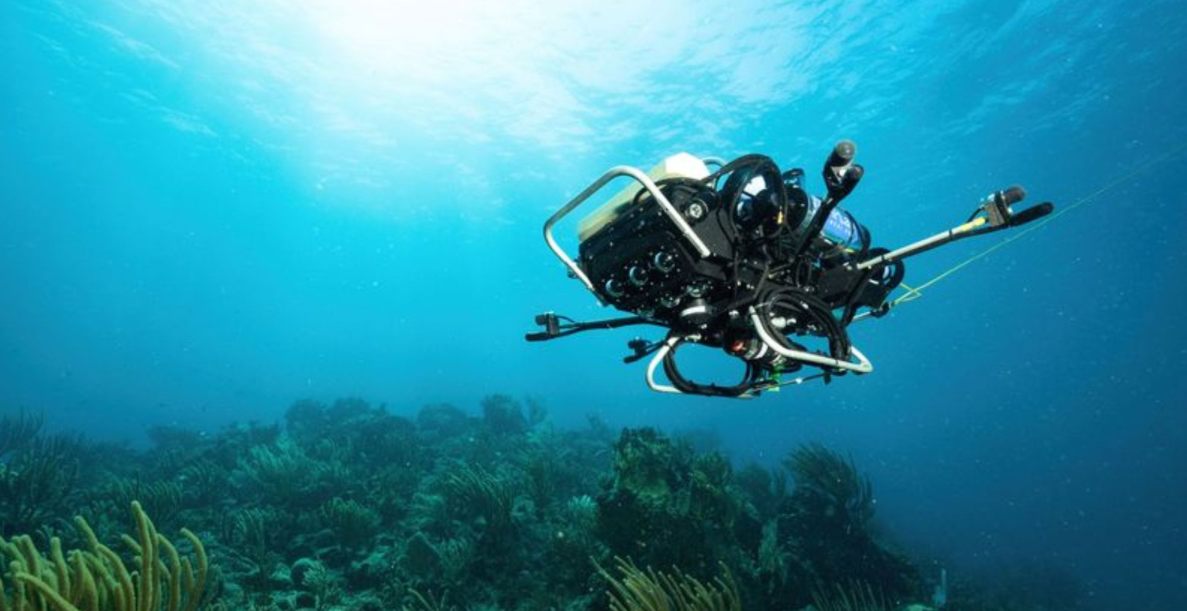 Source: Austin Greene/Woods Hole
While traditional reef surveys typically rely on human divers, the new robot reportedly functions autonomously for long durations and can navigate larger areas without posing a risk to human divers. As it operates, the robot collects both visual and acoustic data, which enables it better to understand how marine life is distributed across reef structures.
Although coral reefs cover less than 0.01% of the ocean, they support roughly 25% of marine species and face growing threats from climate change, overfishing and coastal development, thus making biodiversity mapping critical for conservation.
To enable it to detect both visible marine life and hidden activity based on underwater soundscapes, the CUREE system uses a combination of multiple sensing modes, including visual fish surveys, underwater sound mapping and tracking of species behavior.
Further, the robot can also navigate in the direction of biological signals — like snapping shrimp or fish calls — thanks to sound-guided movement. The system then confirms such findings using close-range visual data, which improves accuracy in reef environments.
“By combining these data streams, the robot can detect distant activity with sound and then verify that with close-up visual observations,” explained the researchers.
During trials, the robot tracked underwater sound sources from distances of up to 80 meters away and autonomously met on reef hotspots from roughly 30 meters away.
The team believes that one day a fleet of these robots might operate globally to monitor reef health and assist with conservation efforts as oceans continue to warm and ecosystems degrade.
The study, “Autonomous seeking and mapping coral reef biodiversity hotspots with a multimodal AUV,” appears in the journal Science Robotics.
