
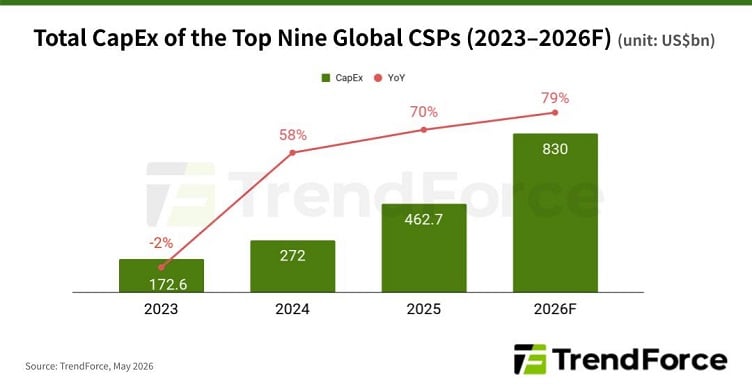
The AI industry is impacting several major North American cloud service providers (CSPs) to raise their 2026 capital expenditure (CapEx) spending to respond to strong AI data center demand.
TrendForce has updated its CapEx forecast for CSPs from the world’s top 9 CSPs to $830 billion in 2026, an annual growth of a whopping 79% from 2025.
Big spenders
Among the four major U.S. CSPs, Microsoft has increased its CapEx outlook to $190 billion, or a spending growth of 130% year-over-year. Microsoft will also spend about $25 billion due to rising component costs, TrendForce said.
Google raised its CapEx spending to $180 to $190 billion, exceeding 100% growth in spending. Meta is now planning to spend $125 to $145 billion, or 85% growth. Finally, Amazon Web Services plans to exceed $230 billion in CapEx in 2025 with more than 50% of the spending driven by demand for AI cloud services, TrendForce data said.
This CapEx expansion among North American CSPs exceeds the global average, which shows how much of a priority the AI infrastructure is becoming with the deployment of high-performance GPU clusters, in-house ASIC development and next-generation data centers to support high-power density computing.
The rise in CapEx corresponds to the momentum happening in data center construction led by these top four CSPs along with Oracle. At the end of 2025, these five companies deployed 800 to 900 data centers globally with AWS accounting for the majority of these.
Outside of North America
Among Chinese CSPs, Alibaba and ByteDance are the main drivers of expansion in CapEx.
Alibaba is focusing on localized nodes and cloud offerings by establishing data centers in Brazil, France and the Netherlands — growing its global footprint to 29 regions and 94 zones.
Meanwhile, ByteDance is aggressively expanding overseas through TikTok into eight countries like the U.S., Brazil, Ireland, Europe, Thailand and Malaysia.
Future power needs
TrendForce forecasts that future jumps in power consumption are coming in 2027 to 2028 as platforms like GB300/Rubin and ASIC-based AI servers enter mass production. This will lead to further growth in components like HVDC power and liquid cooling systems
