
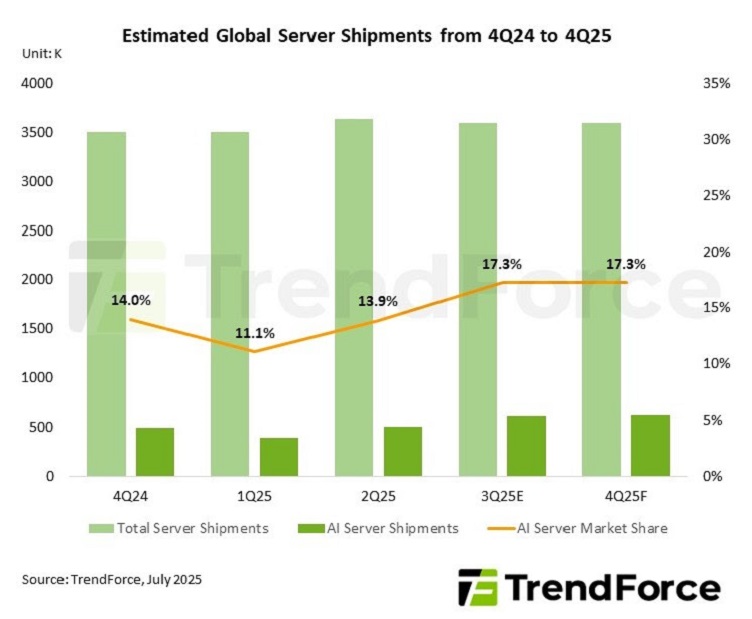
Artificial intelligence (AI) data centers and enterprises are set to expand by double-digit growth in 2025, but geopolitical issues and U.S. export restrictions will lead to less growth this year, according to new data from market research firm TrendForce.
North American cloud service providers (CSPs) and original equipment manufacturers (OEMs) are the primary drivers of AI server growth as these companies — like Google, Amazon, Oracle, Microsoft, Meta and more — have sustained demand for AI data centers.
Due to many server enterprise OEMs readjusting strategies in the second half of 2025 because of tariff policies, geopolitical changes and export restrictions, server shipments for both general purpose and AI will decline by 5%. TrendForce has now revised its forecast to project a 24.3% year-over-year increase in global AI server shipments.
In-house chip development
CSPs are all working on their own in-house AI server semiconductors. All are also in the middle of the development cycle and in the meantime using server chips from the likely sources of Nvidia, AMD and Intel.
This development will continue as these companies seek to minimize costs of these chips and control how they want to perform by developing the chips internally.
Microsoft is adopting Nvidia GPU-based solutions while it continues to work on its in-house application specific integrated circuits (ASIC) development, albeit slowly, TrendForce said. The next generation of Microsoft Maia chips is slated to begin ramping up in 2026.
Meta is also developing its own in-house ASIC, called MTIA, also expected to double shipments by 2026. In the meantime, it is increasing its general-purpose servers based on AMD platforms while expanding its AI server infrastructure.
Google’s AI-inference-focused TPU v6e chips have begun mass deployment and will likely become mainstream inside the company’s server demand and sovereign cloud initiatives in 2025, TrendForce said.
Amazon Web Services (AWS) is focused on its Trainium in-house chips and has begun development on the third generation of devices that will likely begin production in 2026. The Trainium platform has helped AWS accelerate its in-house AI strategy and is expected to double ASIC shipments in 2025 to lead U.S. CSPs, according to TrendForce.
Finally, Oracle is focusing more on purchasing AI servers; however, it plans to push for AI server infrastructure deployment and is increasing its demand for Nvidia’s GB Rack NVL72 devices.
