
June 16, 2000, marked a turning point in biomedical research, when the first rough draft of the human genome was announced.
Assembled from the genetic material of approximately twenty volunteers, it laid the foundation for the Human Genome Project's core ambition then and now: to improve human health. In the years that followed, next‑generation sequencing fundamentally changed how we study biology. By enabling sequencing at the level of individual cells, it transformed our understanding of genomic variation, epigenetic regulation and gene expression.
These advances have made it possible to decode cancer genomes, enable non‑invasive prenatal testing and map the remarkable diversity of cell types in the human brain.
However, the next leap forward in health and life sciences will require looking beyond the cellular level, to the scale of individual molecules. Whether for genomics, proteomics or future diagnostic technologies, the challenge is no longer simply to sequence faster, but to observe biological processes with molecular precision and at unprecedented scale.
Detecting and monitoring individual DNA strands, proteins or enzymes opens the door to applications such as earlier disease detection, more sensitive diagnostics and a general deeper understanding of the molecular mechanisms underlying health and disease. Achieving this vision will demand new sensing technologies that combine single‑molecule sensitivity with scalability and manufacturability.
However, today's dominant readout technologies — largely optical — are constrained by diffraction limits and scalability challenges. Electrical biosensors offer a fundamentally different approach. They can be densely integrated, fabricated using established semiconductor processes, and potentially scaled to millions or even billions of sensing sites on a single chip.
One particularly promising direction is field‑effect transistor (FET)‑based biosensing, where electrical devices directly translate molecular interactions into electronic signals. In recent work presented at the 2025 IEEE International Electron Devices Meeting (IEDM), Imec researchers demonstrated a new biosensor platform based on aligned carbon nanotube (ACNT) bioFETs, taking an important step toward high‑throughput, manufacturable biosensing at the single‑molecule limit.
Building on Imec's silicon biosensing platforms
Imec has a long-standing track record in CMOS compatible biosensors, including silicon bio-finFETs and Si nanowell FETs. These platforms have already demonstrated the ability to detect only a few tens, or fewer, DNA molecules by aggressively scaling the sensing volume.
Yet, several challenges still hinder reaching single-molecule detection with silicon devices. Surface charge screening, oxide-related noise and pH sensitivity impose fundamental constraints on how far silicon-based sensors can be pushed toward reliable single-molecule operation — especially in a manufacturable, wafer-scale context. These limitations motivated Imec researchers to explore alternative semiconductor materials that could overcome these barriers while remaining compatible with large‑scale integration.
Carbon nanotubes: A compelling alternative
Carbon nanotubes (CNTs) offer a unique set of properties that make them highly attractive for biosensing. Unlike silicon, CNTs form atomically thin, pristine semiconducting channels that do not spontaneously create an oxide layer when exposed to liquid environments. As a result, they exhibit reduced surface charge screening and lower pH interference, two major contributions to signal-to-noise ratio in conventional bioFETs.
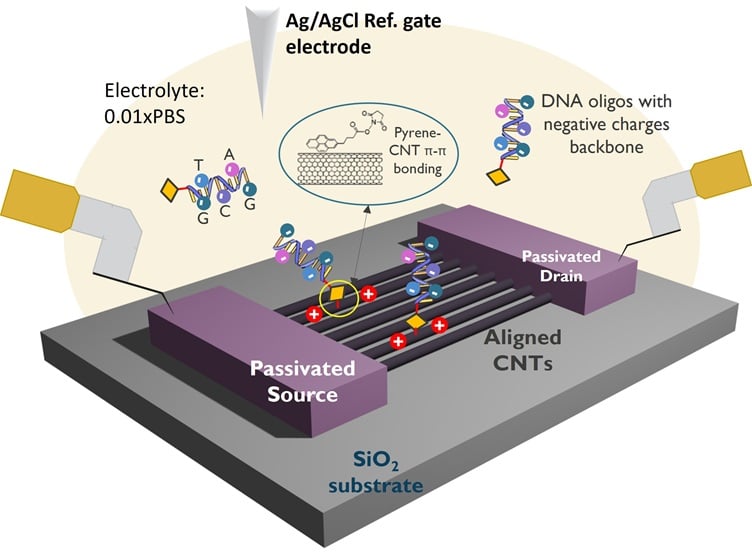
In theory, CNTs also enable highly selective surface functionalization. In Imec's Aligned CNT bioFET platform, biomolecules are attached using pyrene linkers, which bind selectively to the CNT surface via π-π interactions. This selectivity is difficult to achieve on silicon oxide surfaces, where non-specific binding is more common. At present, however, silicon‑based platforms still outperform CNTs in terms of overall functionalization maturity and robustness.
From a system perspective, CNTs offer another critical advantage: back-end-of-line (BEOL) compatibility. This means sensing layers based on CNTs can, in principle, be integrated on top of advanced logic and memory circuitry — paving the way for compact, high-throughput biosensing chips.
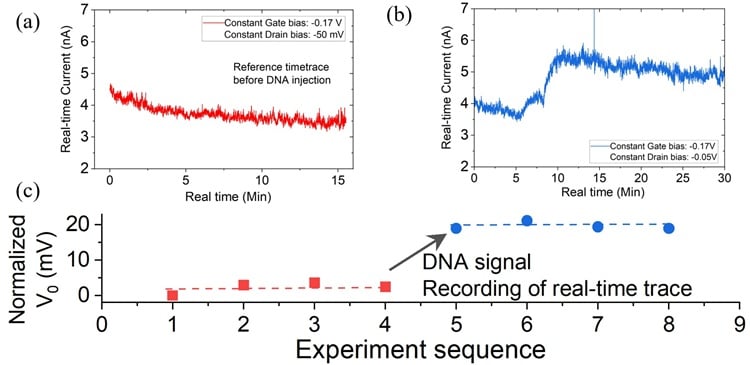 Overview of Pyrene-ssDNA oligos (50T) sensing experiment. (a) Reference real-time without DNA signal; (b) indicate DNA signals after DNA is injected into the system; (c) The variation of the constant current voltage V0 during the experiment with the V0 shift indicating the endpoint signal (≈ 20 mV). ACNT bioFETs were post-treated with TAP 20 cycles. Source: Imec
From single devices to manufacturable arrays
One of the main challenges today in CNT-based devices is the presence of polymer residues introduced during CNT solution processing. These residues can degrade device performance and interfere with biomolecular detection. In the IEDM 2025 work, Imec researchers leveraged an earlier developed transient assisted plasma (TAP) cleaning process onto CNTs to overcome this issue. It effectively removes polymers while preserving the integrity of the CNTs.
By performing in situ comparisons before and after cleaning, the team showed clear improvements in key device metrics such as subthreshold swing (less than 80 mV/dec), transconductance (gₘ greater than 1.3 mS/µm) and threshold voltage stability parameters that directly impact biosensing sensitivity. Importantly, stronger cleaning conditions significantly increased the yield, a crucial consideration for any scalable health technology.
Moreover, while single-CNT bioFETs have already been shown to demonstrate single-molecule detection, such devices are inherently difficult or even impossible to manufacture at scale. Imec's approach is fundamentally different. Instead of relying on individual nanotubes, the team uses dimension-limited self-aligned (DLSA) arrays of aligned CNTs, forming multitube channels with nanoscale width and length. This approach preserves the favorable single-molecule sensing properties of CNTs, while enabling wafer-scale fabrication and reproducibility in the future — a unique feat in the field.
A key enabler of this platform is Imec's expertise in CNT material and device processing, originally developed within its exploratory logic program. The same aligned CNT materials being investigated for future logic applications are now being leveraged for FET biosensing, illustrating the strong cross-fertilization between Imec's nano-electronics and health research.
Demonstrating biomolecule detection
Using this cleaned ACNT bioFET platform, Imec confirmed robust DNA detection in a liquid environment. Pyrene modified single stranded DNA oligos induced a clear and reproducible shift in the transistor's threshold voltage, which serves as the sensing signal. Both endpoint measurements and real time experiments showed voltage shifts in the order of tens of millivolts (greater than 20 mV), comparable to state-of-the-art silicon bioFET, and marking a first demonstration of its kind.
Noise measurements further showed that the ACNT bioFETs already operate on par with state-of-the-art silicon biosensors, despite being an early, lab scale implementation.
While the current experiments involve multiple molecules binding to each device, instead of the desired one, simulations provide a compelling outlook. Using quantum transport models that couple electronic transport with electrolyte effects, the researchers projected single-molecule signal-to-noise ratios exceeding 10 — and even approaching 30 — are achievable in optimized ACNT bioFETs.
Crucially, these projections hold even in conservative scenarios where only one nanotube in an array contributes to the signal. Together, these results underscore that Imec's aligned CNT arrays can combine scalability and single-molecule sensitivity, rather than forcing a tradeoff between the two, an essential requirement for future health and life‑science sensing applications.
Looking ahead
Future research will focus on further reducing noise, continued downscaling of the sensing area and extending the platform beyond DNA detection to single‑enzyme monitoring. Together with Imec's complementary work on solid‑state nanopores and Si nanowell FETs, these advances form a coherent technology portfolio aimed at scalable, single‑molecule biosensing. They illustrate how progress in advanced semiconductor research can be translated into platforms for health and life‑science applications. Imec invites companies active in high-throughput single-molecule analysis to co‑develop tailored applications using our aligned CNT bioFET platform. Through joint research programs, Imec aims to explore new sensing modalities and enable scalable molecular diagnostics and data‑driven life‑science technologies.
About the author
 Lijun Liu is a researcher at Imec. Lijun Liu is a researcher and project lead at Imec. Since joining Imec in early 2021 and securing an FWO Postdoctoral Fellowship in October of the same year, he has dedicated his research to the development of nanoscale CMOS-based biosensors tailored for life sciences applications. His work includes the exploration of Silicon nanowell/nanopore FETs for biomolecule detection toward the single-molecule level (IEDM 2023). Starting from 2024, he expanded his research interests to next generation bioFETs and exploratory logic devices based on novel nanomaterials, such as carbon nanotubes (CNTs) (IEDM 2025), and has been leading the CNT bioFET project since then.
 Koen Martens is the principal scientist at Imec.
Koen Martens is the principal scientist at Imec and holds a Ph.D. in electrical engineering from the University of Leuven (KU Leuven), Belgium (2009). Since 2016, his research interests have been centered around harnessing CMOS technology for life sciences applications, particularly in the realm of massively parallel biosensing for genomics and proteomics.
