
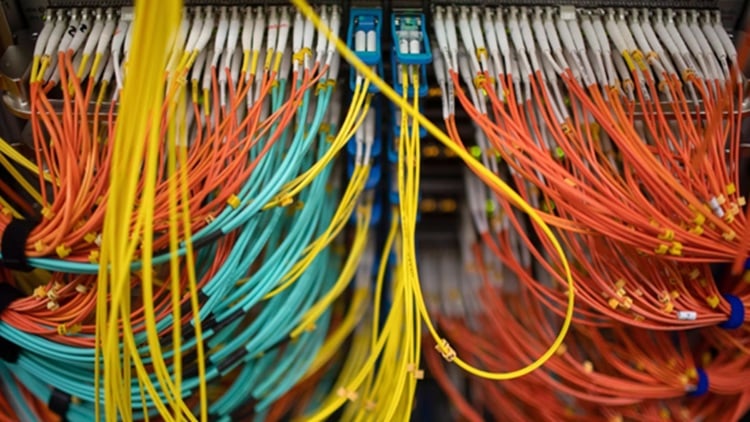
These days, no digital infrastructure would be complete without data centers. A robust and dependable network of connections is crucial, regardless of the sophistication of the servers or the effectiveness of the cooling system. Rugged electronic connectors frequently fill this duty. Despite their often-overlooked importance, these components are fundamental for maintaining consistent power supply, fast data transfer and long-term dependability even when demand is high. This article investigates the different kinds of connectors utilized and the most recent advancements in data center wiring.
Data center connectors
Data center connectors are physical interfaces that allow power or data to be transmitted between various network infrastructure components such as switches, servers, storage devices and more. These parts are available in a range of variations, including copper, fiber optic and power-specific. There are a number of requirements placed on data center connectors during their design process. These include resistance to electromagnetic interference (EMI), the ability to scale and adapt to changing environments, and, in some instances, the ability to endure thousands of mating cycles.
Fiber optic connectors
A fiber optic connector's primary function is to allow signals to be transmitted between optical fibers and various pieces of equipment or patch panels. So, to reduce insertion loss and back-reflection, they need to precisely align the little fiber cores. Fiber optic connectors typically come in lucent connector (LC), standard connector (SC), straight tip connector (ST), multi-fiver push-on connector (MPO)/multi-fiber termination push-on connector (MTP) and more recent designs.
A 1.25 mm ferrule electronic signal transmission component, the LC is commonly used in high-density racks, switch transceivers and SFP/QSFP modules. A square-shaped push-pull fiber optic connector with a 2.5 mm ferrule, the subscriber connector (SC) is a commonly used electrical connector. Legacy networks, telecom backbones and older patch panels all make use of them. Connectors with a straight tip are common in fiber laboratories, campus or multimode lines and in certain industrial applications. Fast connections, spine-leaf networks and parallel optics are best accomplished with MTP or MPO connectors. Systems that are 400G or 800G next generation employ Senko Nano (SN) connections.
Power connectors
In today's data centers, the distribution of power is as important as the transmission of data. Even the most well-planned infrastructure runs the danger of inefficiency and power failures in the absence of dependable data center power connectors. To provide interoperability and security, they are defined according to the IEC 60320 framework. Connectors like this provide power to cooling units, UPS systems, servers and power distribution units; the varieties are designed for assorted voltage and current capacities; and the most popular ones are C13/C14 and C19/C20.
You can think of the C14 as the male inlet and the C13 as the female outlet. Most servers and switches that are housed in racks can be accommodated by their combined ability to take up to 10 amps at 250 volts. Compared to C13/C14, the C19 (female) and C20 (male) connections are superior since they can tolerate up to 16 A at 250 V. Blade chassis, excessively power-hungry servers and big power distribution units often make use of them. Because of its rectangular pin configuration, they form a secure connection that cannot be unintentionally severed.
Copper connectors
Many data centers still rely on copper cable connectors, particularly for older devices and short-range communications. Their low latency, long lifespan and affordability remain competitive with fiber optics, especially at shorter distances. Coaxial, GG45 and RJ45 connector series are some of its most popular varieties.
Ethernet connectivity in many data centers nowadays is based on the RJ45 connector family. Supporting speeds up to 10 Gbps for short distances, it terminates Cat5e, Cat6 and Cat6A twisted-pair cables. Such connections work wonderfully with top-of-rack (ToR) and end-of-row (EOR) designs. Signal integrity and interference shielding are two of the most important reasons to use coaxial connectors. They have a braided shielding layer and an insulating layer surrounding an inner conductor. Included in this category of connectors are the more common BNC, N-type and SMA varieties. In general, communications up to several GHz in frequency are highly desirable.
For systems that use Category 7 or 8 cables, there is a high-performance variant of the RJ45 connector called the GG45 (GigaGate 45). It is compatible with Cat7 and Cat8 frequencies up to 600 and 2,000 MHz, respectively. For sophisticated business networks that are not quite prepared to switch to fiber optics, they make copper infrastructure capable of handling speeds of up to 40 Gbps over relatively short distances.
Conclusion
Connections in data centers are more than simply moving pieces. They specify the flow of data and power throughout the building. Using the correct connector reduces the complexity of long-term maintenance, increases temperature stability and safeguards signal integrity. A lack of density, energy loss and slowed progress on future enhancements can result from selecting the wrong option. Find the right connectors based on your power and signal needs. As data center gear is silently destroyed by heat, connectors need to be able to dissipate heat effectively and remain undamaged even when subjected to high working temperatures.
