
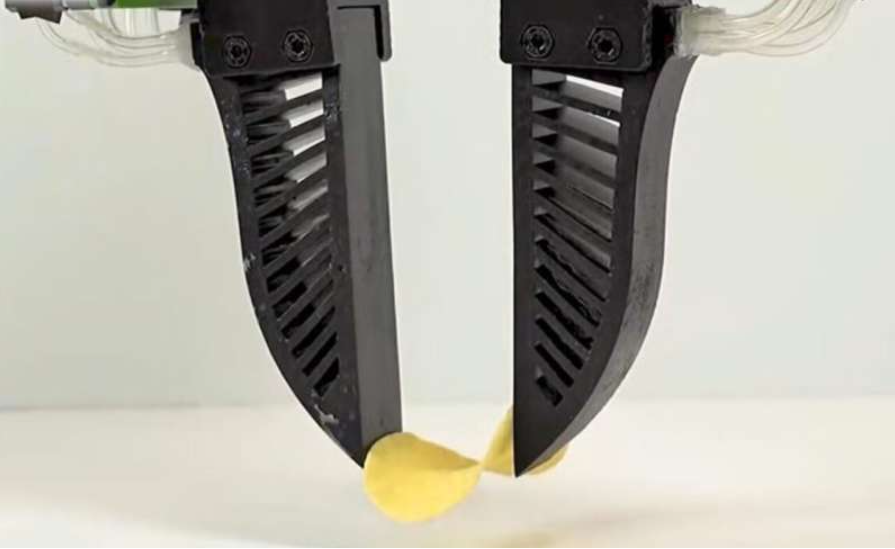
A robotic hand capable of grasping fragile objects — like a potato chip or raspberry — without damaging them has been developed by a team of researchers from The University of Texas at Austin
According to its developers, the robotic hand, dubbed Fragile Object Grasping with Tactile Sensing (FORTE), is capable of a light touch thanks to the combination of advanced tactile sensing and soft robotics.
 Source: University of Texas at Austin
"Right now, robotics is starting to be able to do large motions around the house, but struggles with really fine and delicate movements," the team explained. "Robots can fold a shirt but may struggle to carefully pick up your glasses or unpack fruit from your groceries. "We believe sensing signals will give robots a sense of touch to handle these objects carefully."
Specifically, the robotic fingers central to this technology were inspired by the fin-ray effect — which is a design principle that comes from the natural structure of fish fins. The team built the fingers using advanced 3D-printing techniques and they feature internal, empty air channels that function as tactile sensors.
During trials of the technology, when the fingers prepare to grasp an object, the air channels held inside them shifted, thus incurring changes in air pressure that are detected by small, off-the-shelf sensors that offer real-time force feedback to the robot, letting the robot know if the object is slipping out of its grasp.
When the grippers were tested on an assortment of objects — for instance, raspberries and potato chips, slippery items such as jam jars and billiard balls, and everyday items such as soup cans and apples — the grippers achieved a 91.9% success rate in single-trial grasping experiments, outperforming traditional grippers that rely exclusively on visual feedback.
Further, FORTE reportedly detected 93% of slip events with perfect precision, never producing false slip alerts, thus allowing the robot to adjust its grip only when necessary. Because the sensors operate at near-human timescales, the robot fingers are able to apply just the right amount of force — firm enough to prevent slipping but gentle enough to avoid damaging objects.
Th team is eyeing FORTE for a variety of potential applications including food handling in food processing; instrument handling in healthcare; and object handling in the manufacturing sector.
The system is detailed in the article, “FORTE: Tactile Force and Slip Sensing on Compliant Fingers for Delicate Manipulation,” which appears in the journal IEEE Robotics and Automation Letters.
For more on FORTE, watch the accompanying video that appears courtesy of The University of Texas at Austin.
