
A team of engineers at Northwestern University has built a new class of modular robots called “legged metamachines,” which can reportedly adapt on the go.
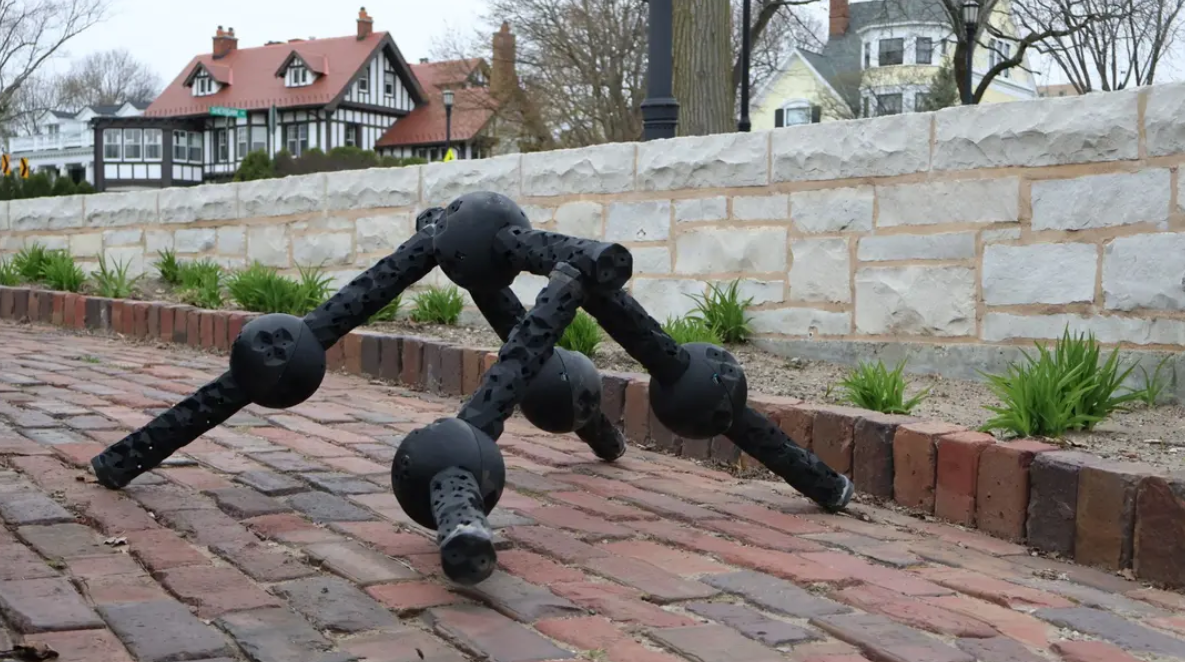
Made up of autonomous, Lego-like modules, each component of the legged metamachines features its own circuit board, battery and motor. Its developers explained that although a single module can roll and jump, when the modules snap together, the legged metamachines’ true power emerges.
 Source: Northwestern University
Specifically, the core components are comprised of half-meter-long modular limbs, while a central sphere connects two elongated, stick-like segments.
“Inside the sphere, the robot has everything it needs to survive: a ‘nervous system,’ a ‘metabolism’ and ‘muscle,'” the team explained. “By that, I mean a circuit board, a battery, and a motor. The modules are mechanically simple. They can only rotate around a single axis, but they are surprisingly athletic and smart,” the researchers added.
The team employed an evolutionary algorithm that mimics Darwinian mutation and selection to identify optimal robot shapes. The AI evolved unconventional modular designs with specialized parts, thus creating unusual, alien-like robots whose movements resemble animals like seals, lizards and kangaroos.
These legged metamachines are built from independent robotic units that enable them to perform complex acrobatics and survive extreme damage that would be fatal to standard designs.
For instance, instead of failing when broken, these robots would reconfigure themselves, with severed parts maintaining their autonomy and continuing to move until they can rejoin the collective.
“They are rapidly assembled and then quite literally hit the ground running. They can move freely in the wild and easily recover from major injuries that would be fatal to every other wild robot. If flipped upside down, they instinctively bring themselves upright and continue their journey. They can survive being chopped in half or cut up into many pieces. When separated, every module within the metamachine can become an individual agent,” the team explained.
The team built three-, four- and five-legged prototypes of the AI’s designs and tested them across assorted outdoor terrains, from shifting sand to tangled tree roots.
During those trials, the legged metamachines reportedly demonstrated autonomy, and performed flips and jumps without any manual recalibration.
Perhaps most important was that because the legged metamachine is ultimately a “robot composed of other robots,” catastrophic damage isn’t fatal. For instance, if a leg is severed, the main body can instantly recalibrate its gait. Rather than the severed limb becoming dead weight, it remains an autonomous agent, rolling and crawling across the terrain until it can eventually rejoin its team.
In addition to being capable of sensing its surroundings, moving from place to place, computing and learning, the legged metamachines can be quickly assembled, repaired, redesigned and recombined.
A study detailing the legged metamachines, “Agile legged locomotion in reconfigurable modular robots,” appears in the journal Proceedings of the National Academy of Sciences.
For more on the legged metamachines, watch the accompanying video that appears courtesy of Northwestern University.
