
A team of scientists from EPFL in Switzerland is using common kitchen ingredients — specifically, citric acid and sodium bicarbonate — to create an edible pneumatic battery and valve system to power soft robots.
While soft, biodegradable robots are used for an assortment of applications — such as environmental monitoring and targeted drug delivery — and are built to disappear entirely after performing their tasks, they tend to rely on conventional batteries (such as lithium) that are toxic and non-biodegradable. So far, no successful system has been created that is capable of providing repeated, self-sustained motion using just edible materials.
 Source: EPFL
As such, researchers at EPFL in Switzerland sought to develop a fully edible power source (battery), valve system (controller) and actuator (the robot's muscle).
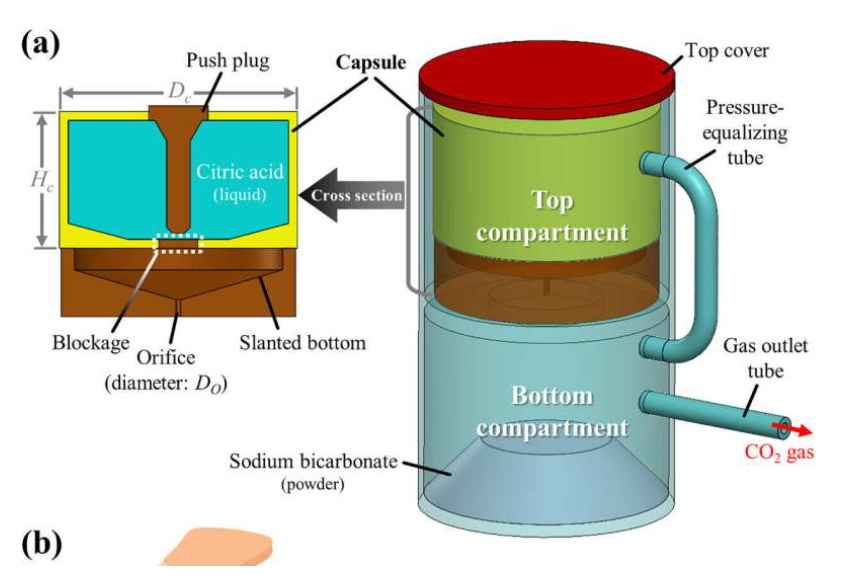
According to the developers, the battery features just two components: one that contains citric acid, which is found in lemons, and the other, which contains powdered sodium bicarbonate, otherwise known as common baking soda. To produce power, the acid is dripped onto the baking soda, which causes it to safely fizz and then release pressurized carbon dioxide gas — the classic "volcano" chemical reaction demonstration commonly conducted in many a classroom.
"The edible pneumatic battery described here relies on the chemical reaction of sodium bicarbonate and citric acid, yielding an energy source that is safe to eat, delivers fast actuation, is low cost, and has zero environmental impact," explained the researchers.
The team added that the carbon dioxide gas flows into the edible actuator, which is composed of soft, flexible gelatin. The actuator bends as the gas pressure builds inside. This bending, the team explained, enables the soft robot's movement.
In the event that the pressure gets too high, it is subsequently released through a gelatin-derived valve. When the pressure drops, the valve will automatically close, thus enabling pressure to build up again from the battery to drive the next cycle of rhythmic movement — a cycle that results in self-sustained motion.
According to the developers, the system is both programmable and scalable, which means it can be tailored for specific missions. Additionally, when the team adjusted the size of the opening through which the acid drips, the scientists could control the rate at which the gas was produced. This reportedly influences how fast the robot moves.
An article detailing the findings, “Edible Pneumatic Battery for Sustained and Repeated Robot Actuation,” appears in the journal Advanced Science.
For more information, watch the accompanying video that appears courtesy of EPFL Switzerland.
