
There’s cold, and then there’s 2025 cold. Atmospheric rivers and Arctic blasts are poised to turn sidewalk commutes into sub-zero endurance tests. As HVAC systems groan under the strain and power grids wobble, engineers, outdoor enthusiasts and construction crews are opting out of environmental dependence altogether. Instead, they are strapping on wearable heat systems designed for mobility, autonomy and resilience.
Today’s heated wearables function less like accessories and more like a distributed climate network. These are not passive insulators. They are dynamic, battery-powered systems that convert nearly every usable watt into directed warmth through advanced carbon fiber, graphene filaments or far-infrared (FIR) elements. At the highest tier, they feature temperature calibration, adaptive learning algorithms and app-based zone control.
While the market is growing fast, a few standout devices deliver unmatched precision, endurance and technical performance.
Foundational principles
The modern heated jacket or glove represents a quiet triumph of materials science. Researchers are demonstrating that carbon fiber and graphene heaters can exceed 95% electro-thermal conversion efficiency. In simple terms, this means almost every electron flowing through these garments can turn into direct heat. The effect is immediate. They reach operational temperatures above 100° F in seconds, maintaining smooth thermal gradients.
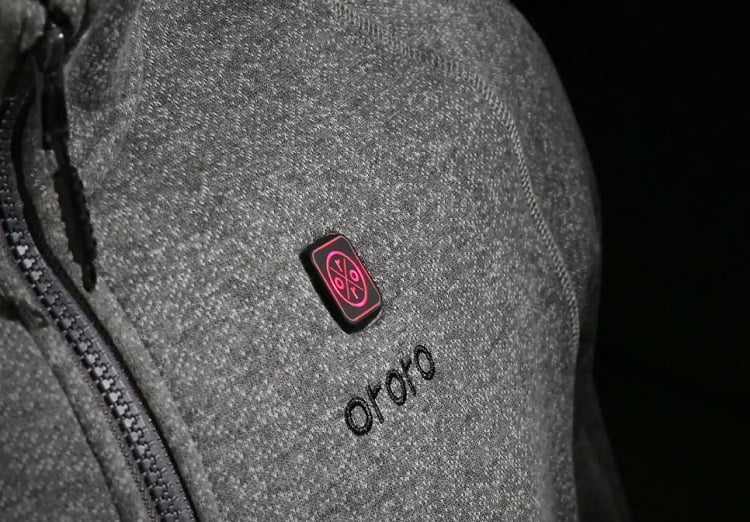 The Soft Shell Heated Jacket by Ororo features four carbon-fiber heating panels for warmth across the chest and upper back. It can be controlled via Bluetooth and last 10 hours. Source: Ororo
Efficiency is only half the story. Control defines the experience. The best heating systems self-tune based on feedback from embedded temperature sensors, using the same logic that drives industrial thermal loops. Engineers have found that carbon fiber textiles can reach 185° F at just 3 watts while maintaining consistent surface temperature across a flexible plane. Graphene nanoplatelet composites achieve similar precision at only 5 volts, offering a balance of low input power and wide heat distribution.
Durability has also evolved. Graphene fibers can be woven or screen-printed directly into textiles, creating washable, bend-resistant conductors. Industrial roll-to-roll manufacturing now embeds reduced graphene oxide into textiles at 150 meters per minute. Paired with thin-film sensor loops that keep temperature swings within 35° F, heated wearables have reached a new equilibrium of performance and safety.
Technologies to watch in 2025
If 2024 was the year of efficiency, 2025 has emerged as the year of refinement. Devices today are balancing comfort and autonomy, along with safety. The U.S. Consumer Product Safety Commission has issued myriad warnings over substandard imports, including recalls of defective heated socks and blankets after reports of burns and fires.
Against that backdrop, reputable manufacturers are setting a new engineering standard.
 Billed as a personal thermal comfort device, the Embr Wave Wristband uses wrist thermoreceptors with controlled waves of warmth to trigger the body’s thermal response. Source: Embr
Core body heating and control
The newest generation of heated jackets and vests emphasizes control of critical zones (e.g., spine, chest, kidney area), moisture resistance and smart energy regulation, rather than brute output.
Ororo Soft Shell Heated Jacket: A benchmark for modular design. Four carbon-fiber heating panels distribute warmth across the chest and upper back, managed through Bluetooth control via the Ororo app. UL-certified 7.4-volt batteries maintain steady output for 10 hours at lower settings and the entire system remains water resistant for field work.
Rukka Outlast PCM Base Layer: Uses phase-change materials (PCMs) originally developed by NASA. Microscopic PCM capsules absorb excess heat during exertion and release it when skin temperature drops, reducing the metabolic roller coaster of heavy layering.
Embr Wave Wristband: Redefines personal thermal comfort by bypassing core heating altogether. The device stimulates wrist thermoreceptors with controlled waves of warmth, triggering the body’s thermal response with minimal energy use.
CORE 2 Sensor: This compact, non-invasive module monitors skin and core temperature, hydration and environmental load. Linked via Bluetooth, it provides feedback loops that help smart systems maintain optimal comfort.
Sony REON Pocket Pro: A bi-directional personal climate module that heats and cools using dual thermoelectric elements positioned at the base of the neck. The latest Pro expands surface area and efficiency, employing adaptive sensors and a Reon Tag system to modulate temperature automatically, based on ambient and body conditions. Controlled through a mobile app, it targets a high-blood flow region along the cervical spine to influence core temperature with minimal power consumption.
 Sony’s Reon Pocket Pro is placed on the back with a connector on the neck. Using sensors and Reon Tag system to modulate temperature automatically, the gadget manages core temperature with minimal power consumption. Source: Sony
Hand and extremity heating
In the cold, dexterity is survival. Modern glove systems balance flexibility, safety and endurance through zoned circuitry and AI control.
Eddie Bauer Guide Pro Smart Heated Gloves: Built on the Clim8 AI platform, these gloves read skin temperature and motion to adjust warmth automatically, conserving energy while maintaining tactile precision.
KEMIMOTO Heated Gloves: Employ composite silk and carbon nanotube heating to provide even 360° warmth across palms and fingers. Their goal isn’t just comfort. They claim to improve circulation and provide relief for cold-sensitive conditions such as Raynaud’s.
Savior Heat Glove Liners: Thin, rechargeable and form fitting, these liners can be worn under other gloves or independently for light outdoor tasks. A reliable entry point for those seeking dexterity without bulk.
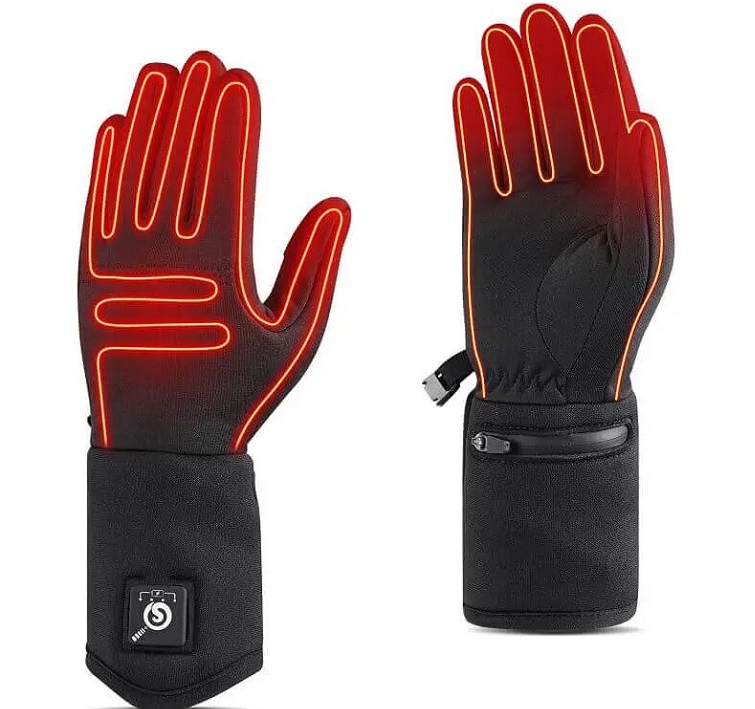 Thin and rechargeable glove liners that allow for users to keep hands warm while keeping their favorite pair of gloves. Source: Savior
Footwear and insole heating
Feet remain one of the most challenging regions to heat effectively due to compression, moisture and restricted airflow.
ELOS Thermal Insoles: Use iron-filing PCM reservoirs that capture and release heat slowly, creating stable warmth without battery drain.
Volt Lava Heated Slippers/Boot: Integrates heating directly into the footbed and midsole using composite conductive fibers and a sealed battery system for up to 14 hours. The boots feature one-touch and Bluetooth control interfaces, combining passive insulation with active heating.
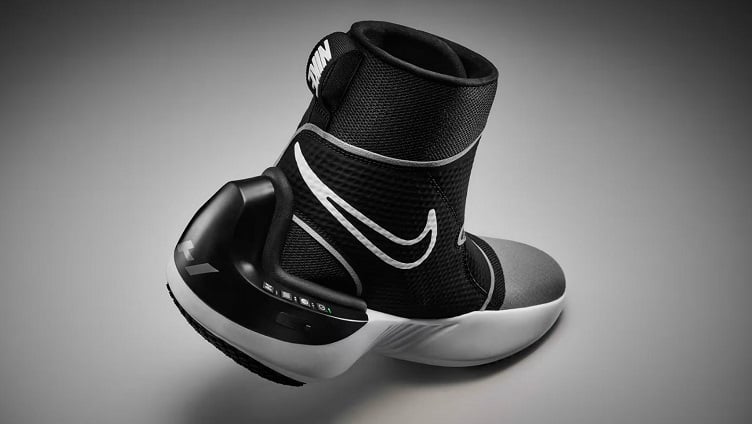
Nike x Hyperice Hyperboot: A high top, battery-powered recovery shoe designed for athletes, merging targeted heat with dynamic air compression technology. Using Hyperice’s Normatec bladder system, the HyperBoot alternates pressure and warmth to drive heat deeper into muscle tissue and accelerate circulation and recovery. Integrated thermal mapping sensors monitor temperature distribution across the foot and ankle to ensure balanced, consistent heat.
Emerging modalities
There are fewer limits to what heated wearables can do now. Engineers are developing multimodal systems that combine conductive, radiative and thermoelectric mechanisms into unified architectures that are capable of warming and cooling on demand. Dual-sided Peltier modules that reverse heat flux in milliseconds have already proven that personal temperature regulation can be rapid and precise. A recent study detailed flexible thermoelectric textiles using bismuth telluride nanostructures embedded in polymer matrices. Such materials can achieve continuous bidirectional heat transfer while cutting energy use by nearly a third compared with resistive systems. In addition, such hybrid fabrics retain stability under mechanical stress, signaling a future where clothing can autonomously balance comfort without constant adjustment.
The design philosophy has shifted from power to perception, and from brute heat to adaptive equilibrium. Engineers are integrating micro-sensing arrays with self-healing polymers and motion-based energy harvesters to extend runtime while keeping garments pliant and lightweight. Supported by NIH-funded research into skin-interfaced thermoregulation networks, these systems merge biofeedback loops with flexible substrates that sense and respond to body heat, sweat rate and mechanical tension in real time. The outcome is wearable thermoregulation that feels alive; an organic interface that manages energy, physiology and environment with silent precision.
Conclusion
Heated wearables are no longer fringe tech for skiers. They have evolved into an adaptive layer of personal infrastructure, engineered for a planet that is colder, harsher and increasingly unpredictable. The convergence of carbon-fiber conductors, FIR emitters, thermoelectric fabrics and bio-responsive polymers moves society closer to garments that think and respond in extreme conditions. The best devices do not overpower the elements.
They negotiate with them to sustain comfort, using intelligence rather than intensity. As winter intensifies, owning one of these systems may feel less like a luxury and more like a quiet act of engineering self-reliance. It is proof that warmth has become portable and can travel in any environmental condition.
