
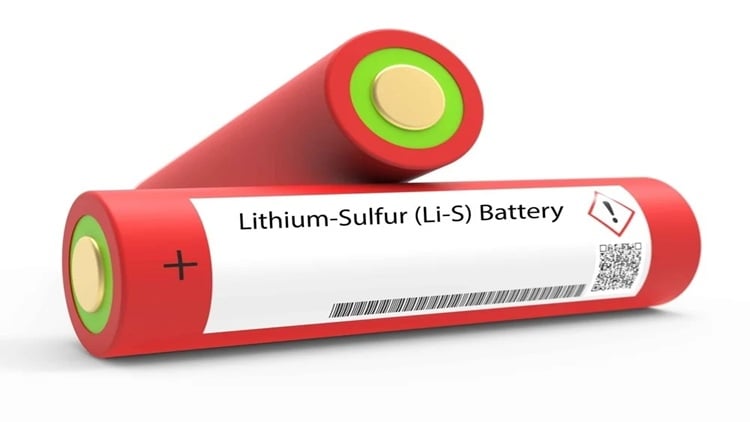
The global push for high-energy, cost-effective and environmentally sustainable batteries has put lithium–sulfur (Li–S) systems at the center of next-generation energy storage research. With a theoretical energy density nearly 10 times higher than today’s lithium-ion batteries, and a chemistry free of scarce metals like cobalt and nickel, Li–S batteries promise lightweight, inexpensive and eco-friendly power solutions. But after two decades of research and thousands of publications, the lingering question remains: are Li–S batteries finally close to commercialization?
This article explores the promise, technical hurdles, recent advances and industrial developments shaping the Li–S commercialization landscape.
Why Li–S matters
At the heart of Li–S technology are two simple active materials: S cathodes and Li metal anodes.
- Energy density: Li–S batteries theoretically reach 2,600 Wh/kg compared to the 200 Wh/kg to 250 Wh/kg of today’s Li-ion packs.
- S abundance: S is the 10th most abundant element on Earth, with a raw material cost of just $0.02 per gram, making it dramatically cheaper than cobalt or nickel.
- Sustainability: Studies show a 31% reduction in greenhouse gas emissions compared to Li-ion, with no reliance on critical or geopolitically sensitive metals.
- Li anode advantage: Li metal has the highest known theoretical specific capacity (3860 mAh/g) and the lowest reduction potential (-3.04 V), ensuring compact, lightweight cells.
Even with current limitations, practical Li–S pouch cells already demonstrate ~700 Wh/kg — almost three times the energy density of commercial Li-ion batteries. This makes them attractive for electric vehicles (EVs), aerospace and portable electronics.
Barriers to commercialization
Despite the extraordinary promise, Li–S batteries face stubborn obstacles that have prevented their leap from lab to industry. The problems lie in the S cathode, the Li anode and the electrolyte.
1. S cathode challenges
- Low conductivity: S is essentially an insulator, with an electronic conductivity of just 5 × 10⁻³⁰ S/cm.
- Polysulfide shuttle effect: During cycling, soluble lithium polysulfides (LiPSs) migrate between electrodes, causing self-discharge, low Coulombic efficiency and capacity fade.
- Volumetric expansion: S expands by nearly 80% upon lithiation, cracking electrodes and degrading structural integrity.
2. Li anode challenges
- Dendrite formation: Needle-like Li dendrites grow during cycling, piercing separators and creating dangerous short circuits.
- Unstable SEI layer: The solid electrolyte interphase breaks down easily in Li–S electrolytes, consuming electrolyte and exposing fresh Li.
- Dead Li: Isolated Li becomes electrochemically inactive, reducing capacity.
- Massive volume expansion: Pouch cell anodes can expand up to 775%, creating catastrophic mechanical instability.
3. Electrolyte challenges
- Traditional ether solvents dissolve polysulfides and are both volatile and flammable.
- Excess electrolyte improves cycle life but drastically reduces energy density — electrolyte can make up 43% of the cell weight.
- Gas formation during decomposition leads to swelling and premature failure.
These interlinked problems mean that while Li–S batteries look perfect on paper, real-world cells suffer from rapid degradation, poor cycle life and safety risks.
Technical requirements for practical cells
To be viable, pouch-type Li–S cells (not just small coin cells) must meet stringent metrics:
- Energy density ≥ 500 Wh/kg
- Cycle life ≥ 1,000 cycles
- High S loading (greater than 5 mg/cm², greater than 70% S content in cathode)
- Low electrolyte-to-S (E/S) ratio (~1.2 µL/mg versus greater than10 µL/mg in labs)
- Balanced negative/positive capacity ratio (N/P ≈ 1.2)
Meeting all these targets simultaneously is the greatest challenge, since improvements in one area (e.g., higher sulfur loading) often worsen another (e.g., polysulfide shuttling).
Academic advances
Researchers worldwide are pushing the limits of Li–S cells by re-engineering cathodes, electrolytes, separators and catalysts.
- Advanced cathode hosts: Porous carbons doped with catalysts (e.g., FeS₂ clusters, 2D MoS₂, vanadium sulfides) trap polysulfides and accelerate their conversion, delivering pouch-cell energy densities up to 441 Wh/kg.
- Electrolyte engineering: New systems like TMS–TTE and DME-6LiFSI-TTE suppress polysulfide solubility and gas evolution, enabling energy densities near 589 Wh/kg with much lower E/S ratios.
- Separators and binders: Janus separators, cellulose nanofiber layers, and sugar-based binders regulate polysulfide migration and improve Li deposition.
- Catalyst design: Electrocatalysts such as FeCoPS₃ or polymer-integrated Li salts accelerate sluggish sulfur redox reactions, improving cycle life.
- Solid-state Li–S: Using solid electrolytes (LLZO, LGPS, Li₇P₃S₁₁) eliminates shuttle effects and flammability, while achieving greater than 500 Wh/kg. Challenges remain in ion transport and cathode/SSE interfaces, but prototypes show remarkable stability.
Industrial efforts and startups
The Li–S market, valued at $32 million in 2024, is projected to reach $209 million by 2029, driven largely by EV and renewable storage demand.
Notable industry players:
- Zeta Energy (U.S.): Carbon–S anodes with high stability.
- Lyten (U.S.): 3D graphene cathodes, improving S utilization.
- Theion (Germany): Pure S crystal wafers fabricated without solvents.
- Li–S Energy (Australia): Boron nitride nanotubes in cathodes, nanostructured Li anodes.
- PolyPlus (U.S.): Glass-ceramic protected Li anodes with aqueous cathode compatibility.
- ARK Power: MoS₂-coated anodes and 3D cathodes, achieving 500 Wh/kg and greater than 1,200 cycles.
- Gelion: Semi-solid Li–S pouch cells using water-based cathode processing.
Meanwhile, Toyota and LG Chem hold the largest patent portfolios but have not released products, signaling that commercialization is still at the pre-market stage.
Outlook: Closing the lab–industry gap
For Li–S to reach commercialization, three research priorities stand out:
- Electrolyte innovation: Solvent-saving and solid-state electrolytes must balance ionic conductivity, stability and safety. Electrolytes that suppress polysulfide solubility while maintaining fast Li transport are critical.
- Stable Li anodes: Protective coatings, artificial SEI layers and alloy buffer layers are being developed to stop dendrite growth and electrolyte depletion.
- Understanding S redox kinetics: The multi-phase, multi-electron S reduction process is sluggish and complex. In-situ techniques and machine learning-guided material discovery are helping identify catalysts and hosts that stabilize sulfur reactions.
Additionally, scaling up from coin cells to pouch cells remains a bottleneck. Lab results often report greater than 1,000 cycles under ideal conditions, but practical pouch cells with high sulfur loading and low E/S ratios typically fail much sooner. Engineering solutions in electrode preparation, stacking, welding and packaging are essential.
Conclusion
Commercialization of Li–S batteries is closer than ever but not fully here yet. Technical progress in electrolytes, cathodes and anodes, plus strong startup momentum, have pushed Li–S beyond lab coin cells into pouch prototypes exceeding 500 Wh/kg. However, challenges like polysulfide shuttle, electrolyte depletion and Li dendrites must be fully solved before reliable, large-scale commercial deployment can happen.
