
The line stopped on Tuesday at 03:17. Not because a bearing failed or a controller crashed, but because a $12 temperature sensor at the far end of the paint line went silent. On the central dashboard, a gray dot was flashing. There was no red, no alarm, just a little gray dot. While forklifts kept moving and welders kept arcing, that tiny sensor's signal had gotten lost amidst the steel racks, motors and human bodies. And a manager's quick calculation was telling him every silent minute was costing thousands.
Anyone who has ever tried to make radios work in these settings knows how hostile they are to wireless signals. Nearly every kind of radio frequency casts some kind of propagation challenge. Interference from motor drives operating across a spectrum, concrete walls that turn into mirrors, bulk material absorption, and multipath fading from metal surfaces. The winning strategy is not about finding the best protocol. It is about assembling a tactical mix of radios tailored to specific transmission properties, power budgets and data requirements.
Physics writes the ground rules
Walk to any industrial site with a spectrum analyzer and watch the chaos unfold. Ventilation ducts morph into accidental waveguides. Mezzanines create multipath corridors that make radio engineers weep.
- At 2.4 GHz, path loss through a concrete wall runs 10 dB to 15 dB.
- Add rebar, and one is looking at 20 dB or more.
- Metal storage racks create Fresnel zone obstructions that cause fades of 30 or more dB, depending on geometry.
- A 50 kW motor drive can raise the ISM-band noise floor by 20 dB.
The fundamental tradeoffs, dictated by physics, are non-negotiable. Sub-GHz frequencies bend around obstacles and penetrate materials better but carry less data. Higher bands move bits fast but fade quickly behind steel and water. Mesh networks route around obstacles finding alternate paths, but every hop adds latency, airtime and maintenance. Star topologies simplify endpoints but push reliability and roaming onto the backhaul.
Wi-Fi where it works…and HaLow where it doesn’t
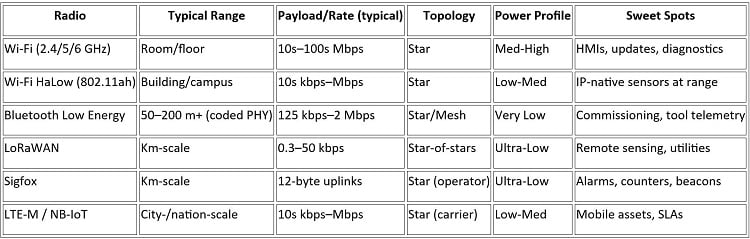
Classic Wi-Fi remains the backbone of plant communications. Most engineers think of it as the ideal technology to connect laptops and smart phones. Production equipment already speaks Wi-Fi fluently, streaming diagnostic logs and downloading firmware updates through access points that professionals understand. But its 2.4/5/6 GHz bands struggle when asked to cross vast warehouse floors or penetrate bulk steel.
Wi-Fi HaLow (802.11ah) is the scrappy industrial cousin that trades raw speed for range and power efficiency, enabling a single access point to blanket an entire facility. Avoid the steep learning curve inherent in exotic wireless tech with network policies that can be applied uniformly and troubleshooting that follows established playbooks.
Early adopters are already deploying HaLow across sprawling logistics yards, campus-wide environmental monitoring and building automation networks that connect thousands of battery-powered sensors directly to the enterprise without breaking the IT budget.
Bluetooth goes blue collar
While HaLow extends Wi-Fi’s reach to cover entire facilities, not every industrial wireless network needs IP connectivity or enterprise integration. Some solutions require connections at arm’s length. This is where Bluetooth excels. Bluetooth technology has evolved into two distinct protocols for industrial use.
Classic Bluetooth manages the practical essentials like serial port replacement for legacy equipment and reliable audio for hands-free communication in noisy environments. Bluetooth Low Energy (BLE) is the protocol of choice for battery-powered sensors designed to operate for years.
BLE excels in configuration, commissioning and low-duty telemetry. Recent advances in coded physical layer (PHY) extension trades bandwidth for forward-error correction, dramatically extending range while preserving minimal power consumption. This even makes hostile RF environments manageable. And BLE’s power management is remarkable.
Sensors running on coin-cell batteries can sleep between measurements and wake only when they have something important to do. In environments where battery replacement requires permits, lockouts and production downtime, that efficiency translates into real economic value.
BLE mesh networks support large scale applications like building-wide lighting control, but they require careful planning. The flooding-based messaging scales well in dense networks but stumbles with long-range links and heavy data loads. The smartest deployments recognize this limitation, using BLE mesh for simple controls where timing is critical, while offloading production telemetry to gateways that provide predictable and low-latency transport.
The long-distance champions, long reach, tiny batteries
When years of battery life spanning kilometers of coverage are needed, low power wide area networks (LPWAN) deliver the appropriate functionality. A collection of technologies that push the boundaries, take the field.
LoRaWAN: The distributed champion
LoRaWAN implements an elegant star-of-stars topology that keeps endpoint devices incredibly simple while concentrating intelligence in centralized network servers. Sensors transmit small packets using spread-spectrum modulation that achieves notable sensitivity to pick out signals buried deep in the noise floor. Network servers choreograph the complexities of adaptive data rates, channel selection and power control, without burdening individual devices.
Agricultural sensors monitor soil moisture across thousands of acres. Utilities watch remote pump stations scattered across rural territories. Smart cities connect everything from parking sensors to air quality monitors through unified networks. It thrives on small, occasional payloads like tanks, meters, manholes, weather stations and campus environmental sensors. It is flexible enough to run private, public or hybrid networks depending on compliance and control needs.
Sigfox: Less is more
Sigfox takes minimalism further. Its ultra-narrowband approach supports uplinks with 12-byte payloads and sparse downlinks. That constraint becomes an advantage for use cases like intrusion alarms, environmental monitors and asset trackers, where power budgets dominate and payloads are tiny. This approach suits simple use cases like:
- Counting door openings
- Tracking pallets
- Monitoring equipment
Cellular IoT: The professional option
Cellular IoT (NB-IoT and LTE-M) brings carrier grade service levels, timing, security and network management to industrial sensing. Monthly service costs buy professional coverage and support, though they create ongoing operational expenses that some applications cannot justify.
Fleet managers value LTE-M’s mobility support that delivers megabit speeds while maintaining coverage. NB-IoT substitutes mobility for building penetration, using repetition and narrow bandwidth to reach remote indoor locations. With its use, shipping containers can report environmental conditions during international journeys and construction equipment can transmit diagnostic data regardless of job site location.
Z-Wave and Z-Wave long range
Although born in smart homes, Z-Wave shows up in light-industrial facilities for door, leak and environmental sensors. It can propagate inside concrete and steel and supports a mature library of devices.
The newer Z-Wave Long Range (ZWLR) swaps mesh for a star topology, accommodating thousands of nodes per network and linkage up to a mile under ideal conditions. For campuses with lots of low bit rate endpoints and a central head-end, ZWLR can be a cost-effective fit, especially where IT prefers to keep non-IP radios segmented behind a gateway.
Choosing your arsenal
Each protocol shines in its own domain, but no single option can carry the weight of industrial operations alone. The real challenge is to combine them into an arsenal that aligns with management practices, security frameworks and long-term strategy.
Experts recommend:
- If batteries must last 5+ years and payloads are small/periodic → LoRaWAN or Sigfox
- If endpoints must live on the enterprise LAN with familiar security/policy → Wi-Fi/HaLow
- If technicians must configure gear with phones → BLE (with gateway backhaul)
- If assets roam beyond the fence line → LTE-M/NB-IoT
- If thousands of low-bit-rate points are present on one campus → Z-Wave LR or LoRaWAN
Yet even the best designed arsenal collapses without coordination. That role falls to gateways, the infrastructure nodes that unify diverse radios into a coherent manageable system.
Gateway and the path to future-proofing networks
Gateways are more than translators. They sit at the intersection of every industrial protocol, transforming a patchwork of radios into a coherent network. They authenticate devices, enforce policies, buffer data during outages and provide operators with visibility into network health. In short, they are the control points where operational reliability and strategic flexibility converge.
Operational role today
Production-ready gateways implement the critical functions that separate successful deployments from expensive failures.
- Identity management: Hardware security modules store certificates and keys, enabling secure device onboarding without exposing shared secrets.
- Performance monitoring: Time-series databases capture weeks of signal strength, retry rates and energy consumption, helping to correlate connectivity issues with environmental changes.
- Data resilience: Local analytics detect anomalies in real time and prioritize essential alerts when bandwidth is scarce.
- Update mechanisms: Over-the-air firmware updates allow devices to evolve without disrupting production schedules.
These capabilities define success today, but value is not limited to present operations.
Future-proofing role
The true value of gateways lies in their ability to adapt to changing requirements. Radio technologies that perform flawlessly during initial deployment may become operational headaches within five years, as standards mature and operating conditions shift. Resilient networks demand ecosystem thinking.
- Modular hardware: System-on-module products with standardized pinouts allow radio technology swaps without full redesigns.
- Multi-protocol support: Gateways that handle multiple wireless stacks ease transitions and help mixed populations of devices coexist.
- Cloud independence: Platforms that accept data from diverse connectivity options keep application logic insulated from underlying transport mechanisms.
With gateways securing both present stability and future adaptability, the broader lesson becomes clear. Industrial connectivity depends less on a single protocol and more on orchestrating the right mix for the task at hand.
Conclusion
Industrial connectivity succeeds through portfolio approaches rather than single-technology solutions. Smart engineers deploy IP-native protocols where existing infrastructure provides natural advantages, choose ultra-low-power options where battery replacement costs dominate expenses and select licensed spectrum where mobility justifies ongoing service costs.
The key principles remain constant regardless of technology choice. There is no single winner. The right combination emerges only by walking the floor with real instruments to find the worst corners. Measuring fade margins when everything is running full tilt and logging packet loss over weeks helps. The invisible infrastructure connecting modern industry depends on engineers understanding the tradeoffs and making knowledgeable decisions.
