
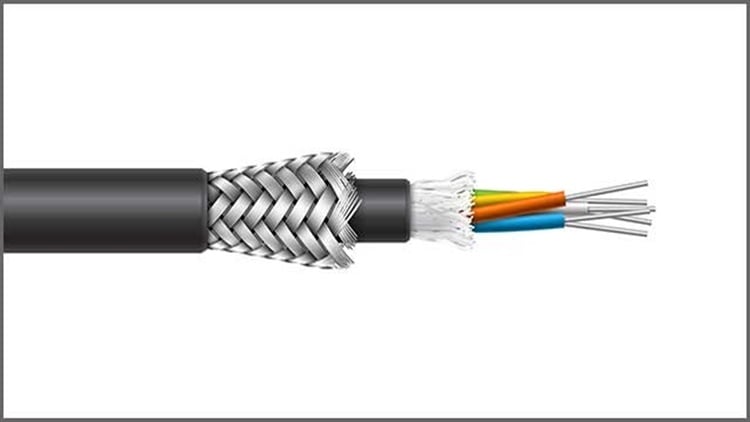
Shielding and grounding are essential strategies for managing interference and protecting electrical cables. Generally, cables fall into two broad categories: power cables, which transmit electrical power at relatively high voltages and currents, and signal cables, which carry low-level signals used for control, communication, or instrumentation.
Types of cables
Power cables are designed primarily to deliver energy safely and efficiently. Due to their higher voltages and currents, these cables are susceptible to electromagnetic interference (EMI) and radio-frequency interference (RFI), which can affect nearby electronic devices and signal integrity. Moreover, power cables must handle fault currents without damage or risk to personnel.
Signal cables, conversely, carry sensitive, lower-level signals, making them vulnerable to noise, interference, signal degradation and crosstalk from other electrical systems. Ensuring the integrity and clarity of signals — such as audio, data or control signals — is critical, hence the need for more precise shielding and grounding methods.
Shielding technologies
Shielding involves enclosing cable cores in conductive layers to prevent EMI from affecting the cable signals or radiating outward. EMI refers to the unwanted disturbance generated by electrical or electronic devices, which can negatively affect the performance or functionality of other nearby devices or systems. EMI occurs when electromagnetic energy from one source interferes with another system’s signals or power, causing disruption, distortion, data loss or malfunction. The choice of shielding depends on the specific application and frequency range of concern.
- Foil shielding uses thin aluminum or copper foil, providing excellent protection against high-frequency interference. Commonly used in communication cables, instrumentation and digital data cables.
- Braided shielding consists of woven strands of copper wire, offering good mechanical strength and flexibility. It is typically employed in audio cables, coaxial cables and industrial control wiring.
- Combination shields blend both foil and braided shielding methods. They offer comprehensive protection across a broader frequency spectrum and are ideal for sensitive instrumentation and high-performance applications.
Grounding methods
Grounding, or earthing, is essential for safely dissipating unwanted electrical interference and fault currents. Effective grounding protects both equipment and personnel while ensuring system reliability and reducing susceptibility to EMI. Some common grounding techniques include:
- Single-point grounding, in which cable shields are connected to ground at one point only. This method minimizes the possibility of ground loops and is widely used for sensitive analog signals and precision instrumentation.
- Multi-point grounding, where cable shields are grounded at multiple points. This method is favored in high-frequency digital environments and robust EMI suppression scenarios, although care must be taken to manage potential ground loops.
- Hybrid grounding, which combines aspects of single and multi-point grounding to manage EMI effectively, is applied in more complex or mixed-signal environments.
Practical considerations and standards
Choosing a suitable shielding and grounding strategy demands careful attention to the following practical considerations:
- Avoiding ground loops: Ground loops can introduce interference through unintended current paths. Proper grounding strategies, isolation transformers and differential circuits can help mitigate these issues.
- Shield termination practices: Typically, power cable shields are grounded at both ends to ensure robust EMI and fault management. Signal cable shields, however, are usually grounded at one end to avoid ground loops.
- Cable separation: Ensuring physical separation between power and signal cables reduces interference significantly, especially critical in industrial and sensitive electronic environments.
To achieve safe, effective and compliant installations, standards such as IEEE 518 (for grounding), IEC 60364 (electrical installations) and the NEC (National Electrical Code in North America) provide essential guidelines and regulations for proper grounding and shielding practices.
Selecting the most suitable grounding and shielding strategy
Step 1: Identify cable type and signal characteristics
Determine whether you're dealing primarily with power or signal cables.
· Power cables: Generally shielded and grounded to handle high voltages, fault currents and EMI generated by large currents.
· Signal cables: Usually shielded for sensitivity, noise immunity and minimal signal interference.
Step 2: Evaluate frequency range and EMI risk
Assess whether the primary risk of interference is from low-frequency or high-frequency EMI:
· Low-frequency EMI: Often from power lines, motors, transformers.
· High-frequency EMI: Typically from digital electronics, RF transmitters, communication equipment.
· For high-frequency scenarios: consider foil shields or combination shields.
· For general-purpose or mechanical robustness: use braided or combination shielding.
Step 3: Consider application environment
Evaluate environmental conditions and specific sensitivity requirements:
· Industrial environments: Robust, multi-point grounding often used due to substantial interference and machinery.
· Sensitive electronics and instrumentation: Single-point grounding preferred to prevent ground loops and subtle interference.
· Mixed environments: Hybrid approaches (combination grounding) are common, carefully balancing EMI control and ground-loop prevention.
Step 4: Understand ground loop risks
Ground loops cause circulating currents, potentially leading to signal degradation. Avoid ground loops by:
· Grounding signal cable shields at one end (single-point grounding) for sensitive instrumentation and analog signals.
· Grounding power cable shields at both ends (multi-point grounding) to handle high fault currents safely.
Step 5: Follow relevant standards and industry practices
Comply with recognized international and national standards:
· IEEE 518, IEEE 1100, NEC and EMC standards provide guidelines specific to cable grounding/shielding in various applications.
Step 6: Factor in practical installation constraints
Practical considerations might include:
· Available space and cable routing constraints.
· Installation simplicity and long-term maintenance.
· Accessibility for grounding points and shield terminations.
Conclusion
In summary, careful consideration of shielding and grounding technologies customized specifically to the type of cable and its application ensures improved reliability, safety and performance across electrical and electronic systems. Select a shielding and grounding approach based on the cable type, frequency range, sensitivity, practical installation constraints and compliance with standards. Balancing these factors will ensure reliability, reduced EMI risks and optimized system performance.
