
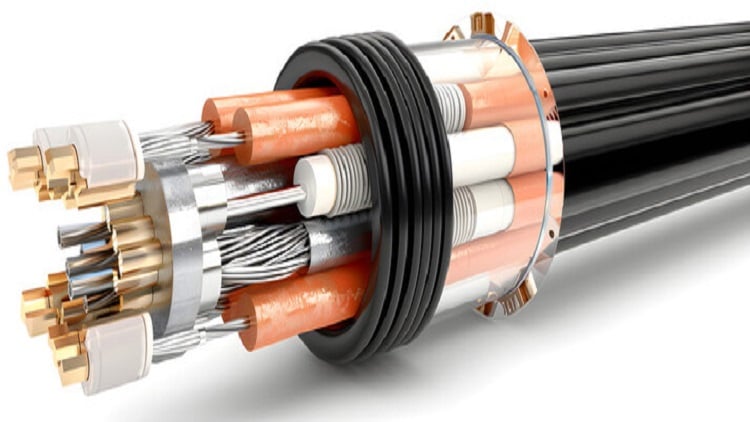
High-frequency cables differ from other cables primarily in their ability to carry signals at much higher frequencies — typically in the megahertz (MHz) to gigahertz (GHz) range — while maintaining signal integrity. Normal cables, such as power cords or basic audio wires, are designed for low-frequency applications and are not optimized to handle the challenges that come with high-speed signals, such as signal loss, electromagnetic interference (EMI) and impedance mismatch. This article will discuss how we can reduce EMI in high-frequency cables.
EMI shielding methods
Shielding
One of the most effective methods to reduce EMI in high-frequency cables is shielding. High-frequency signals tend to radiate energy, which can interfere with nearby equipment or be corrupted by external noise. Shielding involves wrapping the cable in a conductive material, such as braided copper or aluminum foil, which reflects or absorbs electromagnetic waves. This barrier helps contain emitted noise and blocks incoming interference. In sensitive applications, cables may use multiple layers of shielding for extra protection. It's crucial that the shield is properly grounded — usually at one or both ends — to ensure it performs effectively.
Twisted pair configuration
Another key technique is the use of twisted pair cables. This method involves twisting two conductors together, which causes the electromagnetic fields generated by each wire to cancel each other out. This significantly reduces radiated EMI and also makes the cable less susceptible to picking up external interference. Twisted pairs are especially useful for differential signaling, as seen in Ethernet or USB cables, where two wires carry equal and opposite signals. The physical twisting also minimizes loop area, reducing the cable’s ability to act as an antenna.
Proper grounding
Grounding is essential in any EMI reduction strategy. For high-frequency cables, the cable shield or outer conductor must be connected to ground to safely route unwanted noise away from the signal path. At high frequencies, grounding at both ends of the shield is often beneficial, as it allows high-frequency noise currents to return to ground efficiently. However, the grounding method must be chosen carefully to avoid ground loops, which can introduce additional noise. A low-impedance ground path is key to making this method effective.
Ferrite beads and chokes
Ferrite beads or chokes are components that can be placed around or on a cable to suppress high-frequency EMI. These components work by introducing impedance to high-frequency noise while allowing lower-frequency or DC signals to pass with minimal resistance. They are particularly effective for common-mode noise, where unwanted signals are present equally on both conductors. Ferrite cores are often installed near the ends of cables, especially near connectors, where EMI issues are most likely to occur.
Cable routing practices
The way a high-frequency cable is routed can also influence its susceptibility to EMI. Cables should be kept as short as possible to minimize antenna-like behavior. Additionally, they should be routed away from known noise sources such as motors, switching power supplies or fluorescent lights. When high-frequency cables must cross power lines, it's best to do so at a 90° angle to reduce coupling. Proper separation from other cables and the use of grounded cable trays or conduits can further reduce EMI problems.
Applications of EMI shielding methods
Shielding application: Coaxial cables in radio frequency (RF) systems
In radio communication systems, coaxial cables (like RG-6 or RG-58) are commonly used to carry high-frequency signals between antennas, transmitters and receivers. These cables have a central conductor, a dielectric insulator and a braided metal shield (sometimes with an extra foil layer). The shield blocks external EMI and also prevents the signal from radiating outward. Without proper shielding, RF signals would suffer from interference and signal loss.
Twisted pair configuration application: Ethernet cables (Cat5e, Cat6)
Ethernet cables used in computer networking contain multiple twisted pairs of conductors. For example, a Cat6 cable used for gigabit Ethernet includes four pairs of twisted wires. The twisting helps cancel out EMI generated by each wire and also reduces pickup of external noise. This allows high-speed data transmission (up to 1 Gbps or more) even in electrically noisy environments like offices or industrial settings.
Proper grounding application: Shielded USB cables in medical equipment
In sensitive devices like medical imaging systems (e.g., ultrasound or ECG), shielded USB cables are used to connect instruments to computers. These cables have a shield that's grounded at both ends to prevent EMI from affecting signal integrity. A poor ground connection could allow noise to interfere with patient data, leading to inaccurate readings or system errors.
Ferrite beads and chokes application: Laptop charger cables
Many laptop charger cables have a cylindrical "bump" near one end — this is a ferrite bead. It suppresses high-frequency noise that might be generated by the charger’s internal switching power supply. Without it, the charger could radiate EMI that interferes with nearby radios, Wi-Fi or even the laptop’s internal circuits.
Cable routing application: Industrial automation systems
In factory settings, signal cables (like encoder feedback or communication lines) are often routed through cable trays. If these cables are run alongside power cables driving motors or relays, they can pick up noise. To prevent this, installers route signal cables separately, keep them short, and cross power lines at 90° angles. This reduces the chance of induced EMI disrupting control signals.
Conclusion
High-frequency cables are engineered to reduce EMI through the use of foil or braided shielding, precision twisted pair configurations, proper grounding at critical points and the inclusion of ferrite beads or chokes to suppress high-frequency noise. These design features help maintain controlled impedance, minimize signal degradation, reduce electromagnetic interference and ensure reliable high-speed signal transmission even over extended distances.
