
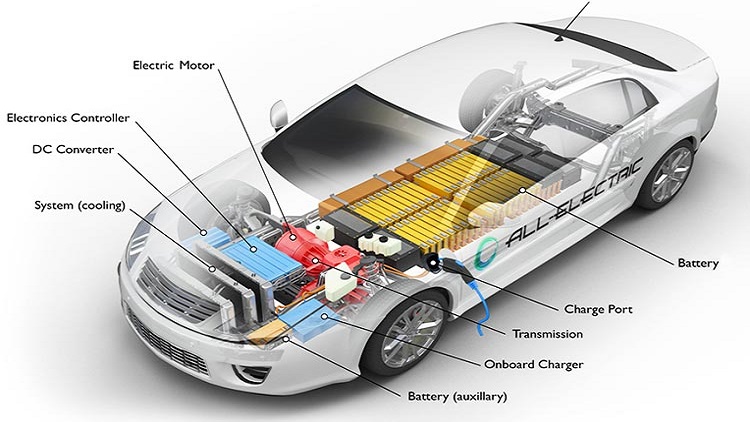
Electrification and increased autonomy are influencing the evolution of automotive electrical and electronic systems. Increases in signal/data communication for vehicle connection, advanced driver assistance systems, infotainment, and autonomous driving as well as the high voltages of electric powertrains have been the primary drivers of development in these architectures. As a consequence, electric vehicles (EVs) generate significant levels of low-frequency electromagnetic interference (EMI) from the high-power electronics used to power the electrical powertrain.
High levels of EMI might pose serious problems in EV applications, where security, performance and efficiency depend heavily on electronics. EVs of the future will generate, transmit and analyze far more data than modern vehicles do, leveraging wireless networking enabled by 5G and vehicle-to-everything technologies, all over low-voltage networks. Meanwhile, the industry is developing new ways to increase current, power and range in batteries, engines and quick-charging technology. All electrical components must be designed to account for the high power and current levels' powerful electromagnetic fields and substantial heat losses.
Sources of EMI in an EV
The following are examples of components within an EV that might generate EMI:
- Operating at high power levels, electric motors generate electromagnetic emissions and provide a conduit for EMI via impedance, which varies as a function of frequency.
- In electric drive systems, power converters are a major contributor to EMI, as their high switching speeds (2-20 kHz) necessitate the use of high-speed switching devices such as traditional insulated- gate bipolar transistors (IGBTs). Higher frequencies are possible with fast IGBTs and metal-oxide- semiconductor field-effect transistors made from silicon carbide.
- Electric and magnetic fields are emitted by traction batteries and interconnectors, opening a door for EMI.
- A wireless charger produces a strong magnetic field to transmit power to the EV, making wireless charging facilities and battery chargers two of the largest external EMI emitters.
- High-current flows between the subsystems of an EV via cables, both shielded and unshielded, result in more intense magnetic fields. Due to space constraints, high- and low-voltage cables are often run in close proximity, which can result in EMI.
Resolving EMI issues
Potential EMI/electromagnetic compatibility (EMC) problems must be addressed by simulation rather than antiquated techniques of trial-and-error prototype testing in order to fulfill the rising needs for EV applications and shorten vehicle time-to-market. Complex EMI issues associated with an EV powertrain under varying conditions need a tailored solution using a number of numerical tools combined into a specialized workflow. Therefore, it is crucial to develop a comprehensive and systematic approach to manage EMI/EMC issues in EVs. This approach should include the use of advanced simulation tools, such as electromagnetic field simulators and circuit simulators, to predict and mitigate potential EMI problems at an early stage of the design process.
The simulated solutions may include:
- Systems and subsystems (S/SS), which can have a variety of dimensions, from 0 (circuit logic/block diagram) to 1 (voltages/currents along cable harness pathways) to 2 (bundle cross-section analysis) to 3 (complexity of the sensors and vehicle geometry).
- Time domain and frequency domain phenomena, such as nonlinearity and switching of an IGBT. The frequency domain is used to quantify the shield transfer impedance of cables and induced currents in the vehicle chassis.
- A physical phenomenon that occurs at several scales (from the micro-scale of components up to the macro scale at the vehicle level).
Agents for EMI shielding
One common technique for preventing EMI is the use of shielding agents such as capacitors and plastics. Filter capacitors, also called EMI filters, are frequently employed as input and output capacitors in EV applications. They filter out the line's background noise and other disturbances. Capacitors often offer EMI filtering on the high-voltage AC side of a system, while on the DC side of a subsystem, they help to filter out the noise and smooth ripples in the voltage.
Creating EMI-resistant enclosures around sensitive electronics is also a method of EMI shielding, while another involves the use of acrylic-based sprays or brush-on coatings that impart shielding capabilities. Using cutting-edge plastics and high-performance polymers, design and electrical engineering teams may have bespoke enclosures 3D-printed to their exact specifications. In EVs, these polymers can help mitigate EMI, severe corrosion and high temperatures.
Plastics that have been coated with metals can also effectively filter EMI because the metal adds the capacity to reflect back certain forms of interference. For further shielding and protection, modern polymers are often coated with silver, copper, nickel or a mixture of these metals. The effectiveness of EMI shielding is material- and thickness-specific.
[Discover more about EMI shielding technology on GlobalSpec]
Conclusion
Due to technological improvements, modern EVs are equipped with numerous electrical parts and systems. The accessibility of navigation and entertainment is great, but the concentration of so many electronic devices in a small area might result in high levels of EMI, which could compromise or even render inoperable the electronic components themselves. Therefore, when designing an EV, it is crucial to use EMI shielding solutions.
