
As part of a research initiative dubbed CURSOR, which includes partners from six EU countries, Norway and the U.K. as well as Tohoku University, a small robot designed for search and rescue efforts has been developed.
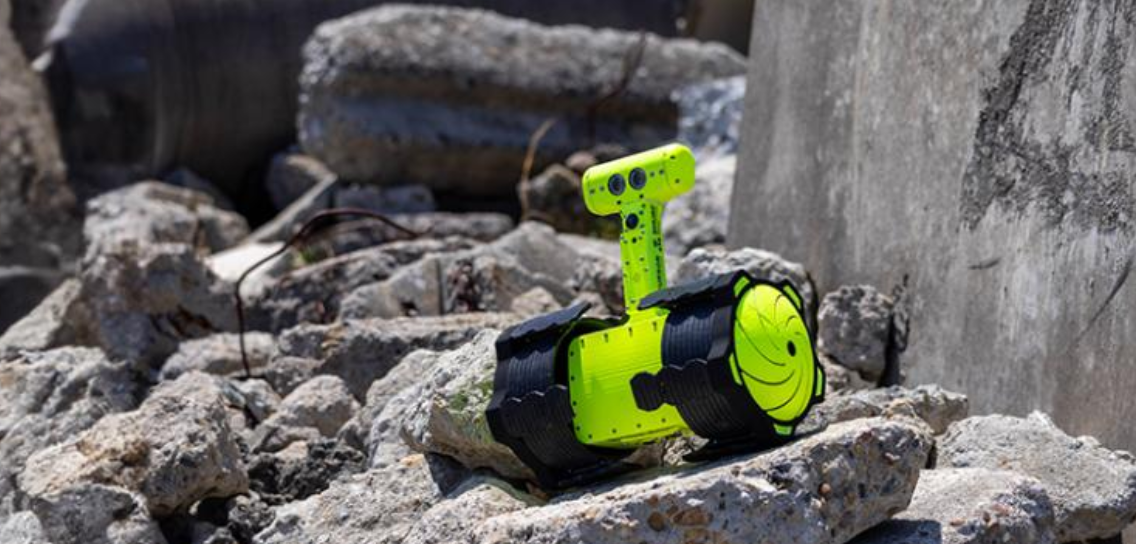
The robot, called Soft Miniaturized Underground Robotic Finder (SMURF), can reportedly navigate through collapsed buildings and rubble piles to locate those trapped beneath.
 Source: Tohoku University
This technology is designed so that rescue teams can perform more functions remotely, localizing and finding humans in the most hazardous areas in the early stages of a rescue operation. According to its developers, the SMURF can be remotely controlled by operators who are a safe distance from the rubble.
Making the SMURF appropriate for this task is that it is compact and lightweight, with a two-wheel design that enables it to maneuver over debris and climb small obstacles.
"It moves and drops deep into the debris to find victims, with multiple robots covering the whole rubble pile," explained Professor Satoshi Tadokoro, a robotics expert at Tohoku University and one of the project's lead scientists.
Further, the SMURF's small "head" features video and thermal cameras, microphones and speakers for two-way communication, along with a chemical sensor called the SNIFFER.
The SNIFFER is reportedly capable of detecting substances that humans naturally emit — for instance, carbon dioxide and ammonia — and it can also distinguish between living and deceased individuals. This helps teams to prioritize getting help to those who are still alive.
During trials, the SNIFFER could make such distinctions even when surrounded by competing stimuli, such as smoke or rain.
The team noted that customized drones are used to deliver these robots directly to the impacted areas where they're needed most, such as places that are hard or dangerous to access on foot.
The team also developed accompanying aerial tools capable of surveying and assessing disaster zones. Specifically, one of the drones, called the "mothership," functions as a flying communications hub, linking all the devices on the ground with the rescue team's command center.
Meanwhile, other drones carrying ground-penetrating radar can be used to detect victims buried beneath debris as other drones can capture overlapping high-definition footage that can be combined together into detailed 3D maps of the affected area, helping teams to visualize the layout.
In addition to expediting search operations, this tech promises to cut the time emergency workers spend in dangerous locations like collapsed buildings.
