
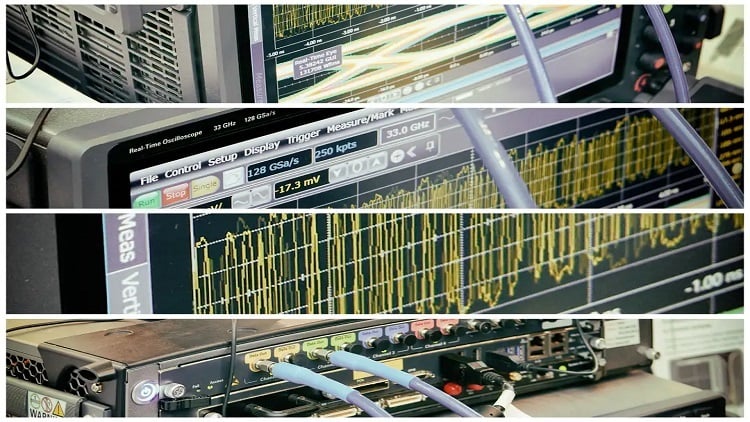
An arbitrary waveform generator (AWG) is a specialized electronic test instrument that can create any waveform shape the user designs, not just standard signals like sine or square waves. The user can "draw" a waveform — no matter how weird or complex — and the AWG will reproduce it very precisely. AWGs offer fine control over amplitude, frequency, phase and shape, and high-end AWGs can generate signals at very high speeds (GHz) with high resolution (e.g., 16-bit). The technology is designed for applications needing highly precise, flexible and fast waveform generation, such as communications testing, radar simulation, quantum computing, advanced research labs and electronic warfare.
Comparison with other waveform generators
Function generator: A basic function generator produces standard waveforms (sine, square, triangle), usually at lower frequencies (~tens of MHz). It’s used for simple tasks like testing circuits. High-end AWG models, in contrast, can generate arbitrary shapes much faster (GHz range) and with much finer resolution.
Pulse generator: Pulse generators are designed specifically to generate sharp, clean pulses (on-off signals) with precise timing. They are usually simpler than AWGs — you can't create arbitrary wave shapes, only rectangular or step pulses. AWGs can also generate pulses, but with much more control (rise/fall times, complex pulse trains, shaped pulses).
Digital pattern generator: Pattern generators output sequences of digital HIGH and LOW signals (like 1s and 0s) for digital circuit testing. They are used for creating logic patterns rather than analog waveforms. Some advanced AWGs (with digital options) can also create digital patterns — but pattern generators are optimized for fast, synchronized multi-bit outputs.
Signal generator (radio frequency (RF) signal generator): RF signal generators are specialized for creating continuous, pure radio frequency signals (from a few kHz to many GHz), often with modulation like AM, FM or digital modulations. Some AWGs can reach RF frequencies but generally are used more for baseband (lower frequency) complex waveforms. RF generators tend to have cleaner, lower-noise outputs at high frequencies.
Other AWGs: Some other AWGs operate at lower speeds or lower resolution. High-end AWGs offer very fast updates and very detailed signal generation for complex testing environments.
Applications of AWGs
Communications (5G, satellite, Wi-Fi)
Modern communication systems (like 5G networks or satellite links) use very complex, modulated signals that vary in frequency, phase and amplitude constantly. An AWG can generate these exact real-world signals for lab testing. Engineers use it to check if phones, routers or satellite receivers perform well even under noisy, variable or very demanding signal conditions — before they are deployed.
Radar systems
In radar systems, the returning signal (echo) from a moving target changes due to the Doppler effect — its frequency shifts based on speed. AWGs can create these "moving" radar echoes perfectly, helping defense and aerospace industries simulate and fine-tune radars. This allows them to train systems to track fast aircraft, missiles or even drones — all without needing live flight tests.
Quantum research
Quantum computers use pulsed microwave signals to control quantum bits (qubits). These signals must be incredibly precise — often with custom envelope shapes, rapid switching and very low noise. An AWG with GHz bandwidth and high resolution is used to craft these delicate control signals. Without such precision, qubit states can be easily disturbed, ruining calculations.
Electronic warfare
In military applications, AWGs are used to simulate hostile electronic environments. They can mimic enemy radar signals, communications jamming signals or complex battlefield electromagnetic noise. This helps train and test defensive systems without real threats, ensuring readiness under a wide variety of signal attacks or interference.
Automotive and electric vehicles (EVs)
Modern cars, especially EVs, have tons of electronics: motor controllers, radars, lidar systems and battery management systems. AWGs are used to simulate real-world electrical noise and signals that these components will encounter. For instance, an EV might need to be tested for how well its electronics perform when there's sudden noise from a high-voltage battery or fluctuating motor signals. Without this lab simulation, companies would have to rely only on expensive and risky real-road testing.
Ultrasonics and non-destructive testing (NDT)
Industries like aerospace, civil engineering and manufacturing often use ultrasonic waves to detect cracks or weaknesses in materials without destroying them (this is called NDT). AWGs can generate high-frequency ultrasonic pulses exactly tuned to penetrate metals, composites or concrete structures. This ensures that airplanes, bridges, pipelines and machines are safe without needing to cut them open.
Medical device testing
Medical electronics — like pacemakers, defibrillators or neurostimulators — must react correctly to very subtle and very complex body signals. AWGs are used to create synthetic heartbeats, brain waves or nerve impulse signals. These synthetic waveforms allow medical engineers to test their devices under safe, repeatable conditions before any human trials. Envision the necessity to replicate a heart's electrical activity continuously for 24 hours — an AWG can accomplish this.
Conclusion
An AWG is a tool that allows engineers and researchers to create any imaginable signal with precise control over frequency, shape and timing. While function generators, pulse generators, pattern generators and RF generators each serve specific tasks, AWGs combine much of their functionality and go beyond, enabling the simulation of complex, real-world scenarios. In industries like communications, radar, medical devices, quantum computing and aerospace, AWGs are essential for innovation, testing and ensuring reliability.
