
The digital landscape has been significantly influenced by two connectivity technologies: 5G and low power wide area networks (LPWAN). Both are titans that serve different masters in the internet of things (IoT) ecosystem. 5G delivers blazing speeds and microsecond responsiveness while LPWAN excels in data transmission across vast distances, using minimal power.
Engineering experts often frame these technologies as rivals for market dominance, but a closer examination reveals a more nuanced reality. These technologies function less as competitors and more as specialized tools that address distinct connectivity challenges.
The relationship between 5G and LPWAN mirrors the symbiosis found in most technological evolution. Each serves a unique purpose while occasionally overlapping in functionality and structure, creating a robust framework for meeting specific needs. This technological complementarity demonstrates that both solutions fulfill essential roles in expanding the IoT ecosystem rather than competing for the same applications.
5G: The bandwidth behemoth
5G reflects the best cellular technology has to offer, shattering previous limitations and offering capabilities that forge new connectivity standards.
- Ultra-high bandwidth: Enables gigabit-per-second data transfers to support video-intensive applications.
- Sub-millisecond latency: Critical for real-time applications requiring instantaneous response.
- Massive device density: Supports up to one million connected devices per square kilometer.
- Network slicing architecture: Creates virtual networks tailored to specific application requirements.
These features make 5G the undisputed champion for high IoT implementations. In smart cities, 5G is leveraged for real-time video analytics that process massive data streams applications like traffic monitoring systems. The millisecond responsiveness enables immediate accident detection and routes emergency services through optimal paths. Simultaneously it adjusts traffic signals to prevent congestion.
In industrial settings, 5G supports operations where failure means disaster. Manufacturing plants that typically use robotic assemblies and control machinery remotely require split-second coordination to be successful. 5G’s low latency and high reliability enable precise coordination of automation, while haptic feedback mechanisms allow remote control from continents far away.
Healthcare applications are another example where 5G’s exceptional bandwidth provides benefits. The technology enables advanced telemedicine implementations where real-time data is critical, including remote surgery and high-definition patient monitoring.
LPWAN: The marathon runner
LPWAN technologies like LoRaWAN, Sigfox, NB-IoT and LTE-M are meant for low power and long-range communication applications. Their design priorities include:
- Ultra-low power consumption: Enables multi-year battery life for remote sensors.
- Extended transmission range: Reaches devices kilometers away from base stations.
- Deep building penetration: Connects devices in challenging environments such as basements, underground installations and behind concrete barriers.
- Minimal infrastructure requirements: Reduces deployment and maintenance costs.
LPWAN is the perfect match for applications that require minimal maintenance and maximum coverage. In smart agriculture, LPWAN sensors with batteries that last for years are spread over vast farmlands to monitor soil moisture, temperature and nutrient levels.
LPWAN is also ideal for smart metering. Water and gas meters transmit data through concrete walls and underground installations. Minimal bandwidth allows scheduled transmissions from millions of devices, reducing costly maintenance visits.
In supply chain operations, LPWAN provides extraordinary range for asset tracking. Shipping containers maintain connectivity during ocean voyages and periodically send data from remote locations where cellular coverage might be nonexistent.
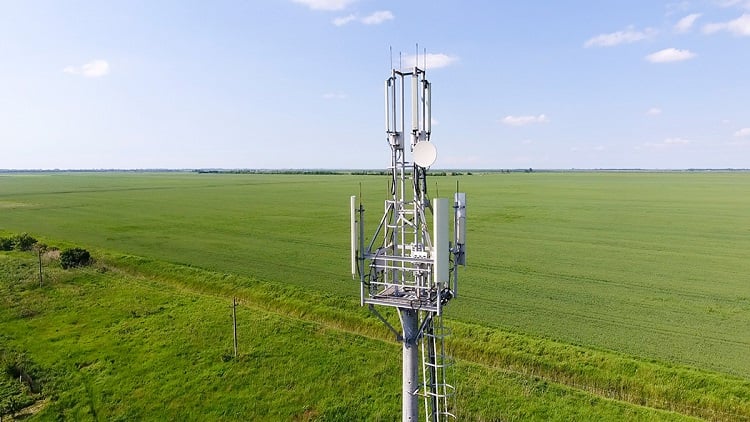 An outdoor LPWAN tower hosting cellular-LPWAN (e.g., LoRaWAN, NB-IoT, LTE-M) hardware in a rural environment. Source: T-Mobile
Harmonious coexistence: The complementary connectivity model
The most sophisticated IoT implementations employ hybrid connectivity architectures, strategically leveraging 5G and LPWAN based on inherent strengths and limitations. Hybrid models use hierarchical data structures where LPWAN handles widespread distributed sensing functions and 5G manages high throughput data aggregation, analysis and real-time control functions.
By nature, these hybrid architectures balance capital expenditure against operational costs through strategic placement. LPWAN reduces maintenance requirements for widely distributed sensor networks while 5G delivers performance advantages for centralized processing nodes. Redundant connectivity frameworks are used to maintain operational continuity during network disruptions by designing fallback pathways between infrastructure types. The integration of these technologies through unified management platforms enables seamless data flow between protocols, creating comprehensive connectivity environments that support the full spectrum of IoT applications while optimizing resource utilization across diverse operational environments.
Competitive friction: Overlapping applications
While 5G and LPWAN technologies largely complement each other in the IoT ecosystem, certain domains exhibit competitive friction due to overlapping capabilities. Engineers face complex trade-offs between performance, cost and operational requirements when selecting the appropriate technology for specific applications. This competition is most pronounced in three key areas:
Mid-bandwidth IoT applications
In mid-bandwidth IoT applications, engineers must balance data rate requirements with power constraints. 5G’s Narrowband IoT (NB-IoT) and LTE-M technologies offer moderate data rates and cellular reliability. They are suitable for urban environments where infrastructure density is high.
However, LPWAN’s ultra-low power consumption and extended battery life often make it the preferred choice for remote or hard to reach locations where energy efficiency is paramount. Engineers must evaluate whether the application demands higher data throughput or longer battery life since these factors directly impact design and maintenance costs.
Private network implementations
Engineers designing private networks must consider the distinct technical boundaries of 5G and LPWAN. For applications requiring sub-millisecond latency and 99.999% reliability, such as autonomous systems and real-time control processes, 5G is indispensable. However, these capabilities come with higher investment costs, specialized maintenance requirements and increased power consumption. Conversely, LPWAN excels in applications prioritizing signal propagation, power efficiency and long battery life, such as environmental monitoring and asset tracking.
Implementation decisions increasingly recognize the complementary nature of these technologies. Engineers design hybrid architecture where 5G supports mission-critical process control and LPWAN handles broader facility monitoring. They use technical evaluations to quantify specific performance thresholds, economic constraints and organizational priorities to determine the optimal technology selection.
Challenging RF environments
Environments with complex radio frequency characteristics, such as manufacturing facilities and warehouses, create connectivity challenges as well. Dense metal infrastructure, concrete barriers and interference sources test the propagation capabilities of both 5G and LPWAN.
LPWAN signals achieve better penetration through structural barriers due to their lower frequency ranges and narrowband transmission. It relies on simplified signal characteristics such as frequency diversity and adaptive modulation, to resist interference. In contrast, 5G achieves consistency through active interference management and multiple antenna arrays for transmission redundancy. Engineers must account for these distinctions, with 5G deployed in areas requiring guaranteed throughput despite interference and LPWAN providing coverage where infrastructure density limits installation options.
Future trends
Current market trends underscore this complementary relationship. The global 5G IoT market is projected to reach $40 billion by 2026 while LPWAN connections are expected to grow to nearly 4 billion by 2030.
As the relationship between 5G and LPWAN continues to evolve, convergent communication standards are blurring the boundaries between these technologies. They enable seamless interoperability and allow devices to transition effortlessly between connectivity types. Edge computing is distributing intelligence across the network, reducing latency and improving responsiveness by processing data closer to the source. Simultaneously, energy harvesting innovations are extending device lifespans by utilizing environmental power sources, while artificial intelligence optimizes network performance through dynamic pathway selection to ensure adaptability to real-time conditions.
Next-generation implementations are narrowing the performance gap, fostering more flexible and efficient IoT solutions. As these trends progress, 5G and LPWAN will continue to shape a cohesive and adaptive connectivity ecosystem, addressing the diverse and evolving needs of modern IoT applications.
Conclusion
The relationship between 5G and LPWAN is defined not by competition but by complementarity, each addressing distinct yet interconnected needs within the IoT ecosystem. While 5G excels in high-speed, low-latency applications, LPWAN dominates in low-power, long-range scenarios. Their coexistence enables a robust connectivity framework that supports diverse IoT applications, from smart cities and industrial automation to environmental monitoring and asset tracking.
As technological advancements continue to shift the boundaries between these technologies, the future lies in their integration. Engineers are encouraged to adopt a hybrid approach, leveraging the strengths of both 5G and LPWAN to create scalable, efficient and future-proof IoT solutions. By embracing this dual-technology paradigm, organizations can unlock the full potential of IoT, driving innovation and sustainability across industries.
