
A small, insect-like robot featuring combined with an inflatable, vine-like robot that grows and curls like a snake has been jointly developed by researchers from the University of Colorado Boulder (CU Boulder) and Purdue University.
The insect-inspired robot, dubbed mCLARI, was developed by CU Boulder researchers, while the inflatable snake robot was developed by a team at Purdue University.
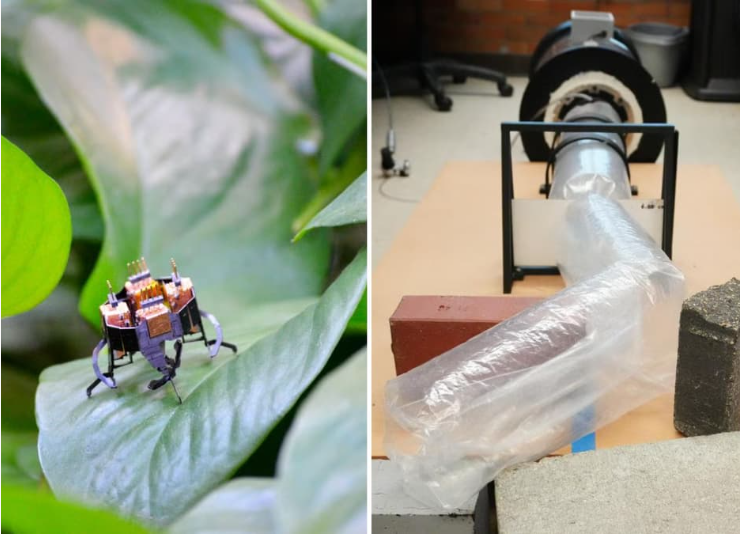 Source: CU Bolder
According to its developers, the combination of robots is expected to inspect and navigate intricate machinery, slipping into tight spaces, such as inside jet engines, and promising faster, cheaper and more effective non-destructive inspections.
mCLARI is a lightweight, four-legged microrobot intended for tight and cluttered spaces and it measures just 20 mm long and weighs just under 1 gram. Further, each leg has two degrees of freedom and is powered by piezoelectric actuators and those legs are connected by passive joints that enable the robot’s body to bend naturally, enabling it to adapt its shape without consuming extra energy. Its developers explained that mCLARI can move at speeds up to 60 mm/s (about three body lengths per second) and is capable of compressing its body to fit into narrow spaces up to 1.5 times smaller than the robot's resting shape.
Meanwhile, the accompanying vine robot system has been created for remote-controlled exploration in real-world environments. The system is operated using a flexible joystick and it is equipped with a camera for live feedback. The robot moves by tip-growing via eversion. This technique allows the robot to extend without pushing against its surroundings, making it appropriate for navigating fragile or confined spaces. The robot’s soft, tubular body enables it to perform smooth turns and adapt to obstacles, even in complex terrains, serving as mCLARI’s transport system, so to speak. Specifically, the soft-bodied robot inflates and conforms to the terrain and carries mCLARI directly to inspection sites located within confined spaces. There, mCLARI relies on onboard cameras and sensors to collect and transmit real-time data for analysis. Once finished, the vine robot retrieves mClari.
“Each of the robotic systems has its pros and cons. By combining the strengths of these two robots, we’re overcoming the disadvantages to create a single collaborative system that can give us quick insight into these compact and confined spaces,” the team explained.
The developers of both robots suggest that together, the technology might be used for disaster response, structural inspections and environmental monitoring, like detecting wildfire-prone areas.
For more on mClari, watch the accompanying video that appears courtesy of CU Boulder.
