
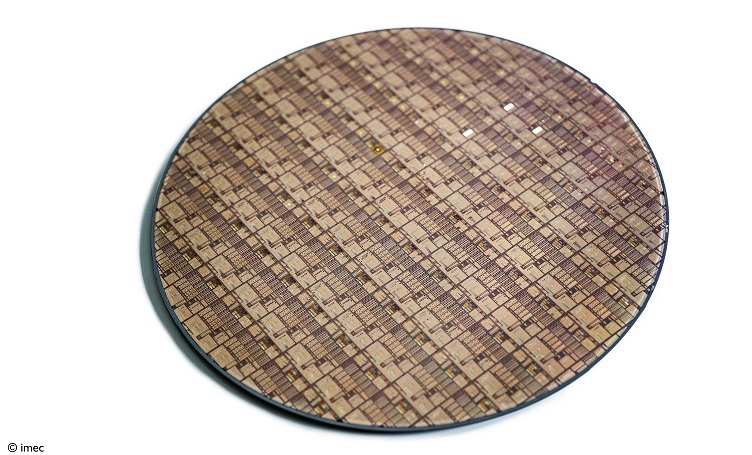
At this week's IEEE ECTC 2025 conference, research hub Imec demonstrated an integrated 300 mm RF silicon interposer platform that combines RF-to-sub-THz CMOS and III/V chiplets on a single carrier.
Imec claims the platform achieved a record-low insertion loss of just 0.73 dB/mm at frequencies up to 325 GHz, paving the way for compact, low-loss and scalable next-generation RF and mixed-signal systems.
According to the organization, momentum is shifting to millimeter wave (30 GH to 100 GHz) and sub-THz (100 GHz to 300 GHz frequency bands. To unlock the potential of these higher frequencies it will require a single carrier that has both a high output power but can also integrate drive capabilities of III/V materials with the scalability and cost-efficiency of CMOS technology.
Chiplet-based heterogeneous systems, built on RF silicon interposer technology enable the integration of digital and RF components, Imec said.
This would be a good fit for advanced applications like:
- Wireless data centers
- High-resolution automotive radar
- Pluggable optical transceivers
- Ultra-high-speed wireless USB solutions
- Short-range device-to-device communications
“What sets our approach apart is the ability to mix and match digital, RF-to-sub-THz CMOS technology nodes with a wide variety of III/V chiplets — not limited to InP, but also including SiGe, GaAs, and others,” said Xiao Sun, principal member of technical staff at Imec.
How it works
The platform has digital interconnects benefit from Cu damascene back-end-of-line (BEOL) processing while the mmWave signal paths employ transmission lines on a low-loss RF polymer layer.
The passive components are integrated directly into the RF silicon interposer, which reduces the active chip area, lowering costs and ensuring compact low-loss RF interconnects for better performance.
Imec said the technology combines RF/microwave lines with high density digital interconnects and a fine flip-chip pitch of 40 µm — with efforts underway to scale down to 20 µm.
The next steps
The research team is looking to augment the platform with more features like:
- Through-silicon vias
- Back-side redistribution layers
- MIMCAPs for supply decoupling
Additionally, Imec will also open its RF interposer R&D platform to partners for early assessment, system validation and prototyping. The technology will be accessible through NanoIC, Imec’s sub-2 nm pilot line, which is part of the EU Chips Act.
ECTC 2025 takes place this week in Dallas, Texas.
