
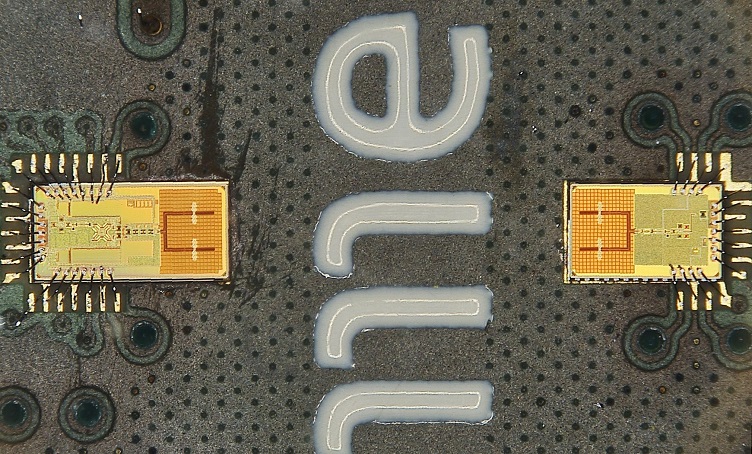
Research hub Imec has unveiled a proof-of-concept for high-precision sensing applications in a photonics-enabled code-division multiplexing (CDM) frequency-modulated continuous wave (FMCW) 144 GHz radar system.
The technology could potentially improve advanced driver assistance systems (ADAS) and other sensing applications. Imec said it successfully demonstrated range measurements that pave the way for multi-node radar systems with improved angular resolution compared to single-node setups.
The technology in the automotive sector could result in 360° radar sensing for ADAS. Other potential use cases include:
- Indoor sensing
- Biomedical imaging
- Vital sign monitoring
Higher radar accuracy requires multiple radar nodes working together but a challenge has been distributing the shared local oscillator (LO) signal across these nodes over long distances without interference, Imec said.
“At this week’s Optical Fiber Communications (OFC) conference, we are unveiling a breakthrough solution to this challenge,” said Ilja Ocket, who manages Imec’s automotive sensing portfolio.
“We are the first to build and test a functional proof of concept for a photonics-enabled, two-node 144GHz Hadamard CDM distributed FMCW radar,” said Ilja Ocket, Imec’s automotive sensing researcher. “By combining analog radio-over-fiber technology with an efficient multiplexing scheme, we ensure that radar units can seamlessly work together.”
How it works
A phase encoder leveraging code-division multiplexing where each node is assigned a unique code sequence for slow-time binary phase modulation. In combination with phase-encoded Hadamard code-division waveforms this allows multiple radar nodes to transmit signals over the same bandwidth simultaneously.
The integration of the phase encoder directly into the optical distribution network and utilizing analog radio-over-fiber technology allows for low-loss transmission of the LO signal over long distances. This reduces electromagnetic interference that maintains the signal integrity necessary for multi-node radar operation.
“Our proof of concept demonstrated successful range measurements and the ability to separate monostatic and bistatic responses, validating both our setup’s potential and the viability of CDM for coherent photonic distributed radar systems,” Ocket said. “As part of this long-term research effort, we now plan to expand the system from two to four radar nodes to further evaluate improvements in angular resolution and scalability.”
