

Unmanned Aerial Vehicles (UAVs) are becoming increasingly ubiquitous both in civilian and military applications. One of the reasons why is their myriad uses in fluid and dynamic situations, such as a battlefield or disaster response area.
One such use is to provide an ad-hoc communications network when infrastructure, like ground-based antennas and fiber optic cables, might not be available. There are several advantages to using UAVs for that role, such as their ability to access line-of-sight to pretty much any point in the area.
However, this also represents a disadvantage if the communication channel is intended to be secure. Finding a balance between the level of security and datalink speed makes for an interesting optimization problem that has been the focus of research for many information theorists for a while.
Secure comms
First, It is important to establish a baseline of why this security is essential. UAVs operating as communications platforms in military zones can provide unparalleled capabilities for ground forces. In ideal situations, they provide a link from any ground forces back to the forward operating base, but also between individual ground forces themselves.
However, a sophisticated enemy would know how important that communication link is and would do their best to either intercept the transmissions and try to decode them or just jam the signal outright. In one case, they receive vital enemy intel that their adversary might not know they have, and in the other, they effectively shut down the communication network that could give that adversary an advantage.
Jamming would be the default in most situations, so even if the information warfare officers responsible for maintaining the UAV comms link enabled advanced cryptography on the channel, their enemy would simply jam it, eliminating whatever tactical advantage it could supply. So, the key is to establish a secure link while also making jamming impracticable.
One way to do that is through a technique called physical layer security (PLS). This technique utilizes the physical environment the signals are sent through to defend against both interception and jamming. It uses techniques like channel hopping, beamforming and, importantly, intentionally transmitted noise to obfuscate and confuse any "wardens" that might be listening.
In information theory literature, a warden is a system that might be listening to a comms line with ill intent. Confusing them is one of the primary goals of establishing a secure communications channel.
Detection versus bandwidth
A paper released initially as a pre-print in October 2023 by researchers from China, India and Saudi Arabia focused on establishing a secure communications line with a high bandwidth while confusing any wardens that might be listening, no matter their sophistication level. It does so by utilizing two different UAVs — one that establishes legitimate communications links with ground forces while the other intentionally jams the frequency both are using.
Intentional jamming might seem counter-productive, but if the jammer and transmitter coordinate correctly, they could easily fool a system simply by sniffing different wireless signals. The jamming signal would be switched off at specific points to allow the real signal to pass through without interruption.
However, to an outside party, there would be no differentiation between the jamming signal and an actual signal, so it would likely simply miss that a message had been passed entirely.
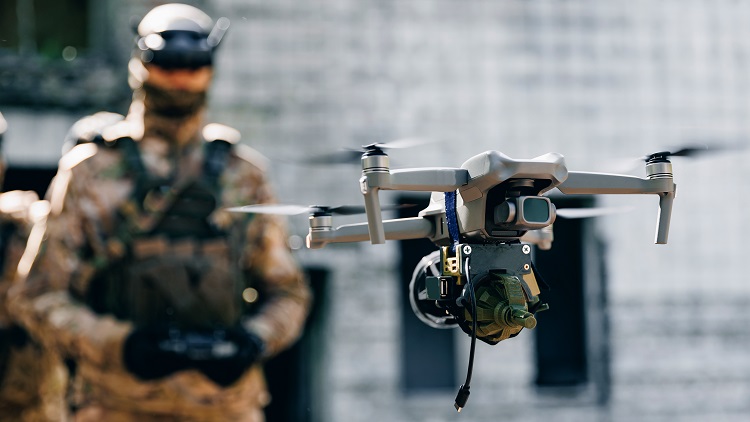 As drones become more prevalent as communications platforms and face down enemies with sophisticated interception techniques, developing secure channels that can't be interpreted or jammed will become even more important. Source: Anastasiia Trembach/Adobe Stock
Two important considerations when designing this kind of coordinated system are the power allocation of the jammer and the transmitter and the trajectory of the UAVs.
Since wireless signal strength falls off exponentially with distance, optimizing the time frame when a signal can be transmitted near a receiving station is essential. A critical factor for increasing bandwidth during that proximate window is increasing the transmitter's signal strength compared to the friendly jammer.
These factors (trajectory, power, chance of detection, signal bandwidth) form a nicely defined optimization problem. That is how the authors designed to tackle the system design — with an optimization algorithm that can maximize the bandwidth received by the ground forces while maximizing the chance the wardens watching the signal would be confused.
One additional constraint on the system is that the wardens will know that a signal exists, so there is no sense in trying to convince them that it doesn't. The goal of the optimization problem is to cause either a false positive or a false negative. In information theory terms, this is represented by the detection error probability (DEP) variable. Maximizing the DEP is, therefore, one of the objectives of the optimization function.
Calculating trade-offs
Saying that the optimization function is complex would be putting it mildly. In optimization theory, the algorithms are designed to find a minimum depending on what value is being optimized for. However, many times in the numerical solution of the function, there are things called "local minima,” which can be thought of as a divet before a steeper drop off the other side.
Getting stuck in one of these is a hazard of most simplified optimization functions, so the authors used a Successive Convex Approximation (SCA).
An SCA algorithm tackles this local minima problem by simplifying its local environment to approximations that can more easily be solved. It does this iteratively to study the approximation around the current point. It gradually improves the approximation over time, allowing it to represent the more complex function more accurately while still treating it as a tractable problem.
The paper applied its optimization algorithm to two scenarios involving wardens with single versus multiple antennas. It was trying to optimize for the secure channel's bandwidth and the likelihood that the wardens wouldn't be able to locate the transmitted signal.
Having only a single antenna proved a real detriment to the wardens, as it was much easier to fool them without the context provided by multiple antennas. Orienting them in a different direction would allow the wardens to see patterns that would otherwise be invisible with only a single one, making the likelihood they would detect the real signal much higher.
However, combining a cooperative jammer with variable flight patterns and power output proved potent. Since this was an academic exercise, the authors were most interested in bounding the likelihood that a warden would be able to pick up on a signal and how fast that signal might be. However, in practice, it would be a binary yes/no as to whether the warden would detect it.
According to the paper, the more antennas, the more likely it would be to catch high-throughput signals. However, if the bandwidth is decreased and the intentional noise is emphasized, it can be harder to detect.
Harnessing drones
Information warfare like this is gaining increasing importance, especially given the increase in the use of drones in almost all modern wars. As drones become more prevalent as communications platforms and face down enemies with sophisticated interception techniques, developing secure channels that can't be interpreted or jammed will become even more important. That effort sounds like another optimization problem to solve.
About the author
Andy Tomaswick is an engineer and freelance writer who is passionate about education, space exploration and improving the world through technology. When he's not engineering or writing, he spends time with his family or runs in circles to stay in shape.
