
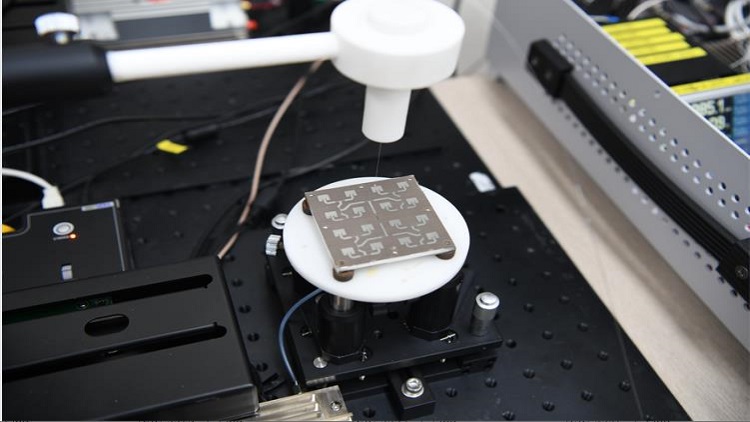
With the advent of 6G communication technology, planned for a frequency range increase of 7 GHz to 24 GHz range, engineers must prepare to avoid the concomitant reduction in communication range. Accurate performance assessments of advanced 6G antennas are needed to identify and avoid malfunctions in prototype designs. In response to this need, a non-metallic sensor-based measurement system has been designed by Korea Research Institute of Standards and Science (KRISS) to gauge both the communication speed and range of 6G antennas.
The electrooptic sensor system described in IEEE Transactions on Instrumentation and Measurement eliminates the coupling effects and resulting distorted measurements commonly encountered with metallic sensors. The lightweight, portable equipment reduces the distance between the sensor and the antenna during measurement from several meters to a few millimeters, with measurement time reduced by more than 1/10.
The integrated sensors were documented to measure pulses with a rise time of 2 nanoseconds to 3 nanoseconds and an electric field strength up to 50 kV/m. The system was confirmed to meet the requirement of the MIL-STD-461G RS105 radiated susceptibility test for transient electromagnetic field such as nuclear electromagnetic pulses.
