One of the challenges of AI-powered simulation is a phenomenon known as “AI drift,” in which models extrapolate inaccurately when faced with uncharted design spaces. The dynamic may be familiar outside the engineering space: ZDNET, Medium and others have recently (and sometimes humorously) reported on AI drift as a reason that ChatGPT is “getting dumber.”
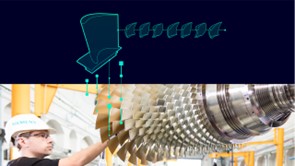 State-of-the-art AI with built-in accuracy awareness helps organizations to fully leverage the digital twin to fine-tune and optimize their products. Source: Siemens Digital Industries SoftwareNot-so-intelligent chatbots aside, however, the problem is significant in the field of engineering simulation. Siemens Digital Industries Software has recently introduced a new solution that brings “accuracy-aware” AI to design space exploration. A new addition to the Siemens Xcelerator portfolio, the HEEDS AI Simulation Predictor actively self-verifies predictions, aiding engineers to conduct simulations that are not only accurate but also reliable in the context of real-world industrial engineering applications.
“With HEEDS AI Simulation Predictor, we have significantly improved various components of the gas turbine, leading to highly optimized designs and accelerated design cycles,” said Behnam Nouri, team lead for engineering and platform design at Siemens Energy. “Our thermo-mechanical fatigue predictions have been effectively upgraded to process ~20,000 design members in only 24 hours, yielding a 20% improvement in component lifetime. This has allowed us to fully characterize the limits of our existing design space … (and) save over 15,000 hours of computational time.”
Key advantages of HEEDS AI Simulation Predictor include:
- Precision product optimization: State-of-the-art AI with built-in accuracy awareness helps organizations to fully leverage the digital twin to fine-tune and optimize their products.
- Faster, more innovative designs: By tapping into historical simulation studies and accumulated knowledge, engineering teams can swiftly craft high-performing, innovative designs, significantly reducing time-to-market.
As a complement to HEEDS, Siemens has also introduced Simcenter Reduced Order Modeling: new software to harness high-fidelity simulation and test data to train and validate AI/ML models. According to the company, these models can enable engineers to perform predictions in a fraction of a second, transforming their approach to simulation.
Key advantages of Simcenter Reduced Order Modeling include:
- Speed and precision: The use of high-fidelity data empowers engineers to gain rapid predictions and to make critical decisions in a fraction of the time it would take using conventional methods.
- Predictive performance: By training AI/ML models on comprehensive datasets, the technology enables engineers to gain robust, reliable and trustworthy insights, helping to eliminate the common issue of AI drift.
“Simcenter Reduced Order Modeling lets us accelerate our simulation models to the point where a detailed fuel cell plant model runs faster than real time, with the same accuracy as a full system model,” said Jurgen Dedeurwaerder, a simulation engineer at Plastic Omnium. “This enables activities such as model-in-the-loop controller development and testing to be done faster, shortening the overall development cycle by around 25%.”
“HEEDS AI Simulation Predictor and Simcenter Reduced Order Modeling represent a true breakthrough in simulation technology. They enable our customers to take advantage of benefits of artificial intelligence-driven simulation to speed their exploration of a design space and to do so accurately and robustly,” said Jean Claude Ercolanelli, senior vice president of simulation and test solutions at Siemens Digital Industries Software. “It also enables them to not only use these breakthrough technologies on new projects, but to leverage decades of past simulation data to help deliver new insights on current projects.”
