
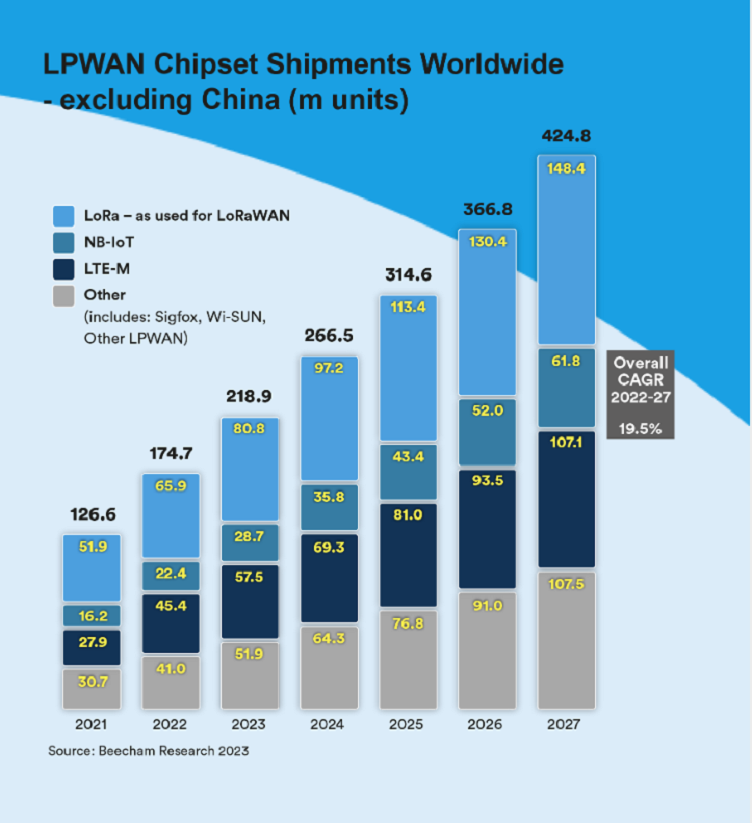
Long range (LoRa) networking chipsets are now the leading chipsets for low power wide area (LPWAN) technology for internet of things (IoT) applications, according to data from Beecham Research.
Shipments of LoRa chipsets, which is the technology behind LoRaWAN networks, are much higher than those of LTE-M or NB-IoT, when China is excluded.
LoRaWAN has been used in several use cases globally to design and implement IoT solutions. It has been particularly used in cases where long-range connectivity needs to be established in conjunction with devices’ low power consumption in real-time low latency communication.
According to the LoRaWAN Alliance, LoRaWAN is significant in applications for three primary uses:
- Indoor operation
- Over long distances
- Low-cost deployment
Beecham Research said that this year 80.8 million LoRa chipsets will be shipped worldwide (excluding China). The next closest chipset is LTE-M with 57.5 million units followed by 51.9 million from other networking chipsets like Sigfox or Wi-SUN. By 2027, LoRa chipsets will grow to 148.4 million units managing a compound annual growth rate of 19.5%.
“Choosing the right connectivity technology for a use case is the most important decision an end-user will make,” said Donna Moore, Chairwoman and CEO of the LoRa Alliance. “Some may not have the in-house expertise to compare requirements to technology options; solutions providers help them find the right-fit technology. Solutions providers analyze use cases, provide education on available technologies, and allow project managers — from city planners to farmers to manufacturers — to envision the full scope of an IoT deployment.”
