
To meet the evolving demands of devices like smartphones, wearables and gaming PCs, there has been a need to boost the capacity, performance and speed of electronics while also making them both smaller and thinner. This has created new challenges for heat management, as noted in a recent article in the International Journal of Thermal Sciences; its authors note that the continued increase in the operating temperature of electronic products will inevitably reduce performance and reliability, even to the point of failure. The study also cites a proposed rule of thumb stating that every 10° C increase in the operating temperature of an electronic component will increase the fault rate by 50%, and a report stating that more than half of integrated circuit failures were caused by thermal problems.
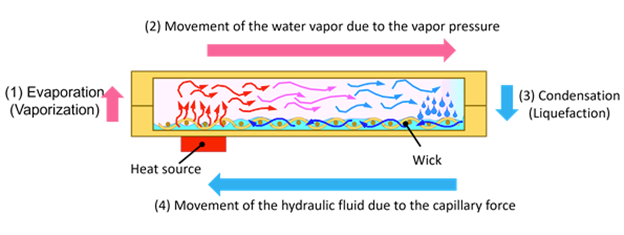 Hydraulic fluid and a wicking material work together in a vapor chamber to provide electronic equipment cooling. Source: Murata Manufacturing Co., Ltd.One answer to this challenge has been the application of various forms of ultra-thin heat pipes. These include both flattened pipes, which are relatively easy to create but limited in shape, and vapor chambers, which can be designed and formed into any shape. The study goes on to describe experimentation around the impact of various materials on vapor chamber cooling capacity.
Moving from academic exploration to real-world product development, advanced electronic materials developer Murata Manufacturing recently partnered with Yasunaga Corporation to develop a new type of vapor chamber wick. Vapor chambers contain a hydraulic fluid (water) and a wicking material, typically made from metal mesh and metal powder sintering, inside a thin metal foil. The hydraulic fluid evaporates in response to heat generated from a source, dissipating the heat in the chamber; once dissipated, the vapor recondenses as liquid and circulates back to the heat source by way of micro-gaps in the wick.
According to Murata, Yasunaga’s new wick material has a capillary force several times that of the conventional wick, enabling the vapor chamber to be reduced to a thickness of less than 200 micrometers while still achieving high heat uniformity.
“Yasunaga has researched and developed micro-metalworking over a period of more than 10 years,” said Akitoshi Yasunaga, company president and CEO. “We have nurtured our expertise in this area to the highest technological level in the world. We are now able to produce an innovative wick by combining the strengths of both of our companies.”
Murata plans to provide the newly designed chamber to a third company, Cooler Master, which will manufacture and sell chambers equipped with the new wick.
