
The ability to tune properties like frequency, radiation beams and other properties in real time is a major feature of the reconfigurable antennas and renders them crucial components for future communication network systems. Some antenna designs are prone to power limitations or malfunction when exposed to temperature extremes, prompting Pennsylvania State University researchers to engineer a reconfigurable compliant mechanism-enabled patch antenna.
“Compliant mechanisms are engineering designs that incorporate elements of the materials themselves to create motion when force is applied, instead of traditional rigid body mechanisms that require hinges for motion,” explained researcher Galestan Mackertich-Sengerdy. “Compliant mechanism-enabled objects are engineered to bend repeatedly in a certain direction and to withstand harsh environments.”
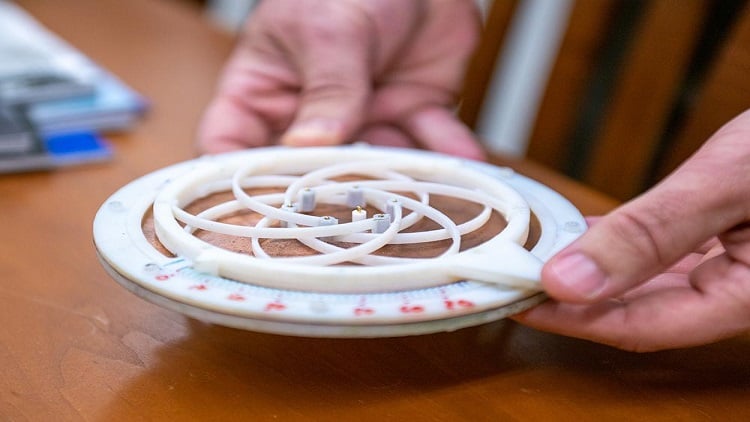
The research published in Nature Communications describes how the complaint mechanism-enabled arms of the redesigned antenna to bend in a predictable way, which in turn alter its operating frequencies as needed. A prototype circular, flower-shaped patch antenna prototype designed using commercial electromagnetic simulation software was 3D printed and tested for fatigue failures and frequency and radiation pattern fidelity.
The reconfigurable antenna was demonstrated to achieve continuously tunable frequency operation across a wide frequency range of nearly an octave. The technology can be scaled to the integrated circuit level for higher frequencies or increased in size for lower frequency applications. The researchers envision its use to augment existing technology and enable performance that would otherwise be impractical, specifically for harsh environments.
