
Increasing integration in integrated circuits is not new, but both chip vendors and their customers are beginning to more closely and more critically evaluate the trade-offs between integration and multiple components. The shift in thinking has significant implications for both the vendors and the design engineers who must be able to justify designing-in these parts.
Historically, as the process and design technology advanced, analog and mixed-signal IC vendors added closely related functions, such as integrating a voltage reference and I/O with the A/D conversion core. This made sense, since the designer absolutely needed these associated functions for a complete converter.
Vendors are now able to add many more diverse and complex functions to ICs as design tools and processes have improved, noted Bob Dobkin, chief technical officer at Linear Technology Corp. However, the integration objective has changed: whether called an ASIC (application-specific integrated circuit) or an ASSP (application-specific standard product), the integration of functions on an IC is now being tailored to specific end-market needs.
Consider an IC for driving the various displays in a car, meeting the unique I/O and driver specs as well as the voltage-rail and operating-temperature requirements of that application. While of high value to auto engineers, the customized IC is of little value elsewhere. So the vendor has to justify the new chip based in part on whether the target market is big enough to make money.
Typically, higher levels of integration in mixed-signal ICs—those with a substantial analog components—make sense for both vendors and users. Maxim, for example, recently announced that such integration would be a major part of its business strategy in the future. Today, about half of the company’s revenue comes from such components.
The vendor’s rationale for these highly integrated mixed-signal ASICs has pros and cons. Many of today's standard parts, such as op amps, have gotten so good that they meet the needs of large numbers of users. The law of diminishing returns then sets in, where “a slightly better part may often have trouble finding enough customers to justify the cost of bringing it to market," said Nihal Godambe, director of market intelligence at Maxim.
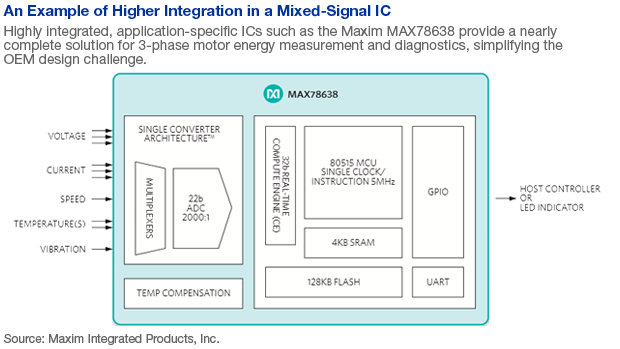
With ASICs and ASSPs, vendors can leverage their design expertise into higher-margin parts, since the perceived value of higher integration by the customer exceeds the value of using a collection of individual components. The vendor’s relationship with the customer becomes much more of a design partnership, as each needs the other to succeed: the vendor to recoup its costs, and the customer to gain the benefit of an integrated design solution.
From a user perspective, the rationale for using these ICs is clear. They simplify the design and circuitry challenge, embed necessary firmware, reduce the footprint for printed circuit boards, increase reliability and reduce the items on the bill of materials and the total BOM cost. In short, these ICs do more of the work, so the design team doesn’t have to. Given the complexity of so many of today's products and the time-to-market and cost pressures, these components usually make a lot of sense.
The “Second Source” dilemma
But higher levels of integration can mean higher risk for the buyer. Since they are application-specific and come from a single vendor, the ICs are often unique. Users rely on the vendor for qualification of the part to performance and regulatory standards, plus applications software, test suites and more. This can be a problem if the sole-source vendor has delivery issues or if the part has performance and specification problems.
In contrast, by designing-in smaller building-block ICs, the user minimizes risk by sourcing from an alternative source and can play one vendor against another to whittle down the price.
Just because the vendor claims to be able to package all the mixed-signal components in a single IC doesn't mean it can. It may be a tougher challenge than expected, or there may be inherent technical conflicts. For instance, co-locating a noisy DC/DC regulator with sensitive analog circuitry, or an RF channel, may be expecting too much.
Even deciding what to make and what to leave out is a challenge. Linear’s Dobkin pointed out that understanding the specification trade-offs means knowing deeply what you can do versus what the customer wants. Finding that right balance often requires integrating a little less to reduce cost, risk, complexity and time. It also increases the number of potential customers. He noted that “sometimes a two- or even three-IC approach is the better trade-off.”

Customers want a vendor "with a solid track record and balance sheet, as well as technical expertise, so startups can be a risk,” said Godambe. "Only a handful of players can do this; you need top-notch IP and a portfolio of single-function parts that you can begin to integrate," he added.
For vendors that have what it takes, the decision can be tough to justify. First, there's the development cost and risk, neither of which scales in linear fashion: an IC with three times as many functions typically is much more than three times as costly to design, verify and test.
Dobkin pointed out that designing new integrated components can consume a "disproportionate amount of your technical and design resources, so there's an opportunity cost as well." Further, that commitment is based on the assumption that customers will materialize. When they don’t, the product may not reach the volume needed to cover the high upfront costs.
Finally, there's the issue of customer loyalty. “There’s little loyalty" in some markets, admitted Dobkin. "You may hit it big on this round, but for that next generation, you could easily be shut out by a competitor that claims to be able to deliver more for less, and in less time, too," he added.
Ironically, Maxim’s Godambe pointed out that "long-life markets are often happy to keep using single-function parts."
For vendors hoping to leverage their intellectual property and design expertise by designing more highly integrated mixed-signal ASICs, there's a tricky path to navigate: find a large market with many small-to-medium-sized customers, a long, cautious design-in cycle and an even longer viable product life. Medical, industrial and energy metering markets have the right attributes, in contrast to many consumer markets that don’t – think smartphones.
Designer engineers who assume that a complex, mixed-signal IC will be the key to their success also find it's a challenge. There's much more pre-decision evaluation required with highly integrated components, since a vendor's historical track record on delivery and pricing are not the only relevant factors. Going the ASIC/ASSP route requires careful assessment of the vendor’s component models, simulation tools, software drivers, embedded firmware, reference designs, test suites and applications support.
Will the more integrated ASIC/ASSP be the path to user and vendor happiness? As in most things, the answer is: "it depends." Expertise, execution, market opportunity and designer realities will all have a role. As well as selecting the right integration opportunities.
COMMENTS
Piyush Sevalia, Executive Vice President, Marketing at SiTime, provided comments to this article that Electronics360 added on June 28, 2013.
Regarding the choice between a single MEMS approach and multiple crystal sources.
Sevalia: MEMS timing has a more standardized supply chain, offers shorter lead times and easy capacity expansion, and ultimately, is less risky than a proprietary quartz supply chain.
Regarding the fact that most timing devices are not sold directly to the OEM, but instead are part of a chipset.
Sevalia: Timing chip are mostly sold to the OEM. Chipset suppliers want to focus on their SOCs and they do not have the expertise to build timing chips. I have not seen an example of a large SOC provider bundling (selling) timing ICs with their reference design.
Regarding test issues for timing devices compared to other ICs.
Sevalia: MEMS oscillator companies use standard, production semiconductor testers from Teradyne that are used by the entire semiconductor industry – in the case of quartz, many use Saunders, which is a proprietary tester that is only used by the quartz industry. Alternately, they build their own testers.
Regarding quartz vendors doing MEMS.
Sevalia: We build our own analog and MEMS chips. Quartz companies routinely outsource their analog chips to boutique semiconductor design houses. Therefore, we are in a unique position to provide expertise on clock specs, measurement techniques and more.
