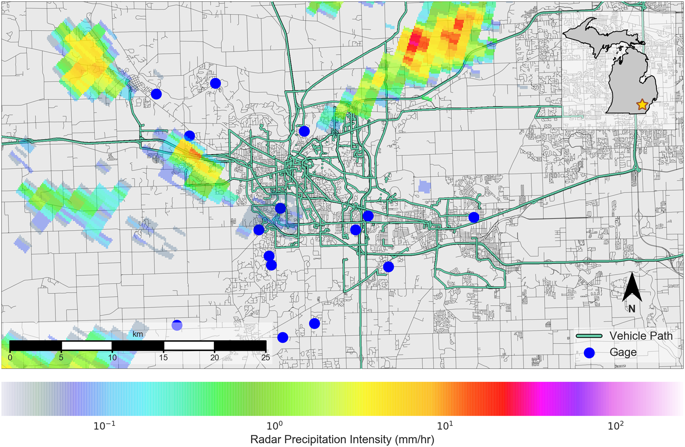
 Overview of the study area on June 12, 2014. Blue circles represent rain gauges. Vehicle paths are shown as green lines, while roads are shown in gray. A radar overlay shows the average precipitation intensity as estimated by radar. Source: University of Michigan
Connected vehicle technology can take some of the stress out of driving by making travel safer and simpler. These vehicles may soon also serve as environmental monitors, starting with sensor-equipped windshield wipers that track rainfall.
A fleet of 70 cars was outfitted with sensors embedded in windshield wipers and dashboard cameras by University of Michigan researchers. Sensor data was used to gauge when wipers were being used, and were aligned with video camera data to document rainfall. Tracking windshield wiper activity was demonstrated to provide faster, more accurate rainfall data than radar and rain gauge systems currently in place.
Flood warnings are now derived from a combination of satellite-based radar tracking and spatially dispersed rain gauges. Both are limited by poor spatial resolution, lacking the ability to capture what's happening at street-level.
The availability of real-time data — such as that from connected cars — could enable communities to act more quickly to prevent flash-flooding or sewage overflows. Combined with stormwater systems outfitted with autonomous sensors and valves, municipalities could potentially use data from connected vehicles to predict and prevent flooding.
The researchers developed a Bayesian filtering framework that generates improved rainfall estimates by updating radar rainfall fields with windshield wiper observations. The resulting rainfall field estimate captures rainfall events that would otherwise be missed by conventional measurements.
The research is published in Scientific Reports.