
Those who studied engineering in college may remember making multiple trips to the lab in their efforts to learn how to operate a variety of instruments that would prove invaluable to their future. They may also have experienced the need to calculate the best times to visit, increasing their chances that the lab equipment was not already in use by fellow students. Among the many challenges to be conquered by those just starting out, this one probably seemed inevitable. But a new device from Liquid Instruments, the Moku:Go, offers an elegant solution: an eight-instrument, remote-access platform that trades trips to the lab for a device that is compact enough to be carried in a backpack.
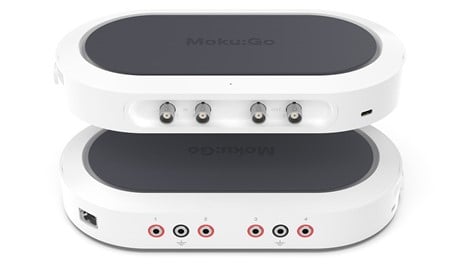 The Moku:Go is billed as an “engineering lab that fits in your backpack.” Source: Liquid InstrumentsIn the place of bulky benchtop instruments comes the freedom to learn on-the-go, with an intuitive interface for both Windows and Macintosh platforms and connectivity via Wi-Fi hotspot or USB-C. Optional two- or four-channel power supplies offer user programmability with the capacity to handle high voltages and currents. The device also features MathWorks Live Scripting and application programming interface (API) support for Python, MATLAB and LabVIEW.
If any of this sounds somewhat familiar, it may be because the Moku:Go is a takeoff on a product marketed to research-and-development environments for the past four years, the Moku:Lab. That device is a customizable platform featuring up to 12 high-performance instruments which, according to a press release, has enabled breakthrough research in the areas of photonics, electronics and materials science. The new device, geared toward students and hobbyists, is available at a fraction of the cost — and even comes in six colors with appealing names like sage, storm, blush and fire (and, for traditionalists, white and black).
The Moku-Go’s range of on-board instruments includes an oscilloscope/voltmeter; frequency response analyzer, spectrum analyzer and logic analyzer/pattern generator; arbitrary waveform generator and waveform generator; proportional-integral-derivative (PID) controller; and a data logger. Electrical protection features are also in place to ensure that students and hobbyists can explore new projects without putting themselves or their equipment at risk.
Liquid Instruments adds that they are “bringing the user experience out of the flip-phone era” with software designed to appeal to a generation accustomed to intuitive user interfaces and broad compatibility. Perhaps most importantly, the student-centric design with its diagrammed views of the signal processing chain supports the learning of core concepts — as opposed to merely the learning the equipment itself.
Features of the Moku:Go include:
- Analog inputs/outputs: Two 12 bit, 125 MSa/s channels
- Input bandwidth: 30 MHz
- Input range: Up to ± 25 V
- Output bandwidth: 20 MHz
- Output range: Maximum ± 5 V
- Digital I/O: 16 channels at 125 MSa/s
- Logic level support: 3.3 V (5 V tolerant)
- Dimensions (W x H x D): 9.4 in (24 cm) x 1.5 in (3.8 cm) x 5.1 in (13 cm)

