
Researchers from UCLA Samuel School of Engineering created a smartwatch that can track the wearer’s drug levels by analyzing chemicals in sweat and this data can be used to create a more personalized approach to medicine.
The new smartwatch is equipped with a sensor that analyzes tiny droplets of sweat, which reflect the drug levels in a person's body. Drugs have their own unique electrochemical signature and the wearable can accurately detect that signal against the backdrop of signals from other molecules circulating throughout the body. Additionally, the sensor can be personalized to look for a particular level of medication.
For their study, the team tracked the effect of acetaminophen, a common over-the-counter pain medication. They monitored individuals over a period of a few hours, stimulating their sweat glands on the subjects' wrists by applying a small electrical current. This allowed the team to detect changes in body chemistry without requiring participants to exercise.
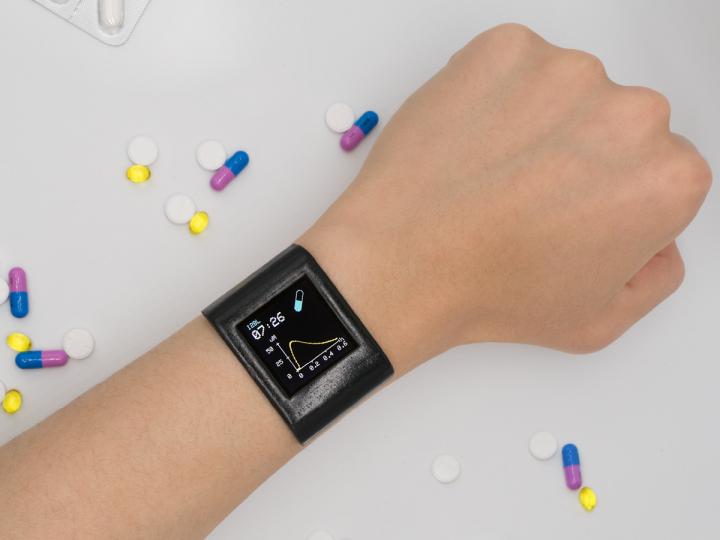 Smartwatch to track medication levels. Source: Jialun Zhu, Shuyu Lin and Yichao ZhaoThere is currently a one-size-fits-all approach to prescribing drugs, which is based on statistical averages of effectiveness, guidelines for weight and age factors, and body chemistry. Likewise, each person's genetic makeup is unique, which affects how drugs are absorbed, how they take effect and how they are eliminated from the body. However, a one-size-fits-all approach does not take into consideration these individual characteristics.
Similarly, drug dosage personalization is difficult. It relies on repeated blood draws at a hospital and samples have to be sent out and analyzed in central labs, making the process inconvenient, time-consuming, expensive and invasive.
Researchers believe that the wearable can help optimize drug dosages for each patient and offer personalized approaches to pharmacotherapy.
A paper on this research was published in the Proceedings of the National Academy of Sciences.
