
The Proteus series has been launched by Tabor Electronics as the world’s first arbitrary waveform transceiver. The instruments integrate the ability to transmit, receive and perform digital signal processing in one unit and offer valuable tools for research in quantum physics, medicine, aerospace, telecommunications and automotive fields. For synchronized, phase coherent, multi-channel applications, such as quantum physics and radar applications, the Proteus arbitrary waveform transceiver is an ideal, space efficient and cost-effective solution.
Aerospace engineers will be able to perform real-time data streaming and fast feedback loops with an environment-dependent waveform generation. A four channel Proteus P2584M could emulate four independent 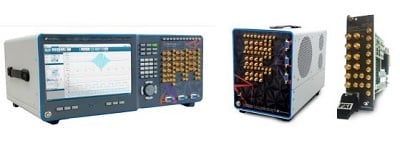 Source: Tabor Electronicshigh-resolution target pulses to test artificial intelligence algorithms. As an arbitrary waveform generator, it can also emulate frequency-modulated continuous wave radar modulation.
In communications, new transmission standards that fuel the next generation of connectivity, such as 5G, Wi-Fi-6 and UWB, all rely on utilizing significant amounts of spectral bandwidth. A 9GS/s Proteus is an ideal instrument for generating wideband signals up to 9 GHz. With a sampling rate of 9GS/s and a bandwidth of 9 GHz, it allows the instrument to generate signals in multiple Nyquist Zones with very wide bandwidths.
Available in dual, four, eight or twelve channel 9 GS/s 16 bit configurations, the Proteus instruments include an integrated numerically controlled oscillator for digital up-converting to microwave frequencies. A 5.4 GS/s, 9 GHz bandwidth, 12-bit digitizer option allows for the configuration of a complete arbitrary waveform transceiver system.
