
Researchers from Duke University created a dynamics simulator that models blood flow through the human arterial system at subcellular resolution. The goal was to provide doctors with guidance in their treatment plans by simulating a patient’s vasculature and predict how decisions or alterations to the blood flow affect surgical outcomes.
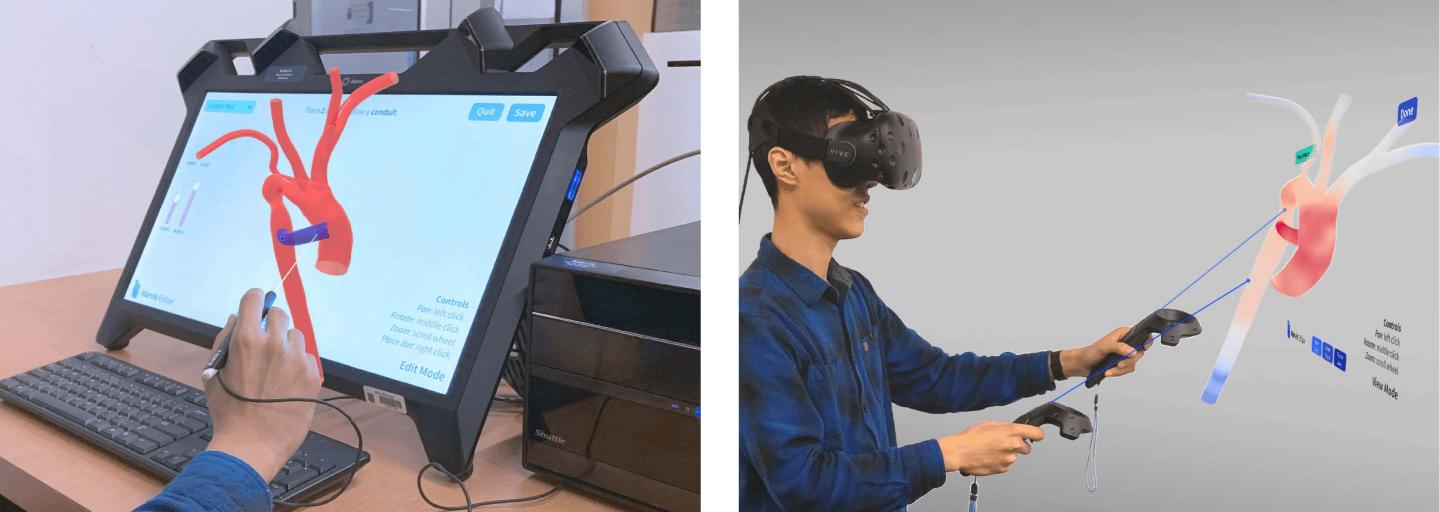 Research scientist Harvey Shi demonstrates a new virtual reality interface that doctors could soon use to help make medical decisions such as where to place stents on a patient-by-patient basis. Source: Harvey Shi, Duke University
The team’s blood flow simulation tool is called HARVEY. The team hopes that HARVEY can be used to understand the stent treatment and cerebral aneurysms and the growth of aneurysms. They also wanted to create a quick and noninvasive way to check for peripheral arterial disease and understand how circulating cancer cells adhere to tissues. While helpful, HARVEY currently requires the user to have knowledge of C coding and command-line interfaces, which is not user friendly and limits who can use the program.
To create a user-friendly interface, the team explored various kinds of interfaces ranging from the standard desktop displays to completely immersive VR experiences. The team found that the more futuristic interfaces may be the key to the widespread adoption of HARVEY.
The team created a graphical user interface called Harvis, which will allow anyone to use HARVEY. To test Harvis, a group of medical students and biomedical researchers simulated three situations using the interface. The first situation was placing a conduit between two blood vessels. The second situation was expanding and shrinking the size of a blood vessel. The third was placing a stent within a blood vessel. The tasks were attempted using Harvis with a standard mouse and computer screen, a “z-space” semi-immersive virtual reality (VR) device or a fully immersive VR device with an HTC Vive device.
The results showed that students and researchers could use the standard mouse and keyboard interface and the fully immersive VR device equally well quantitatively and qualitatively. The semi-immersive display, which consisted of a special pointing tool combined with a monitor and 3D glasses, was ranked behind the other two. The participants had issues adjusting to the unique hardware setup and controls.
There were no major differences between the most and least immersive interfaces in quality and efficiency. The team noticed a major difference between the user’s reaction to the equipment. People appeared to enjoy the 3D interface more, and the researchers believe this means they would be more likely to use it. The VR system could be a fun way to get students engaged in glasses about vasculature systems and hemodynamics.
The team has plans to run more experiments to see if the 3D blood flow interface could help medical students retain knowledge better than current standards. Tools like HARVEY and Harvis could assist in treatment planning like stent placement in a VR interface. Researchers expect that these tools could facilitate biomedical research in a personalized flow space.
A paper on this research was published in the Journal of Computer Science.
