
An ultrathin, flexible neural interface was engineered by researchers from Duke University, Northwestern 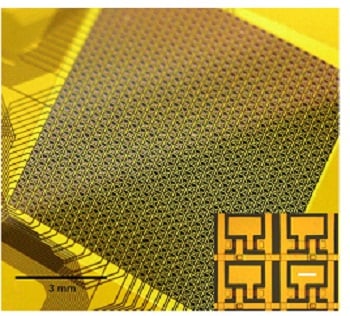 Photograph of 1,008-channel neural matrix array. Inset: Each electrode is connected to a unit cell consisting of two flexible silicon transistors. Source: Chia-Han Chiang et al.University and New York University to provide a long service life for brain monitoring and mapping. The biocompatible device is synthesized with a thermally grown layer of silicon dioxide less than a micrometer thick.
The interface withstands the unforgiving environmental conditions for foreign materials within the brain and degrades at an acceptable pace of 0.46 nm/day. The design, produced with standard silicon fabrication processes, includes over a thousand channels with fewer than 100 external wires, achieved through integration of flexible, active electronics at each electrode contact.
The ability of the multiplexed electrode array to detect neural activity through capacitive sensing was demonstrated in tests with laboratory animal models. A 64-electrode neural interface was implanted into a rat for over a year and a 1,008-electrode neural interface was inserted into the motor cortex of a monkey.
The devices described in Science Translational Medicine are expected to withstand implantation for more than six years. The researchers are now scaling up the neural interface to include more than 65,000 electrodes to enable accurate data collection across larger brain regions, and look to commercial complementary metal-oxide-semiconductor technology to allow neural interface systems to scale to millions of electrodes.
